HSBC to round out tokenization offering via custody play

HSBC is getting set to offer digital assets custody services to institutional investors just a week after enabling the ownership of tokenized gold.

The London-based company’s upcoming capability would allow for the safe-keeping of tokenized securities — such as bonds and other products — issued on third-party platforms.

The offering, which would not custody other crypto assets or stablecoins, is expected to go live in 2024, the company said Wednesday.

HSBC is for now steering clear of custodying crypto assets beyond tokenized securities as such currencies remain “to a large degree unregulated,” a person familiar with the matter told Blockworks. 

The financial giant is set to…

Read more on Blockworks
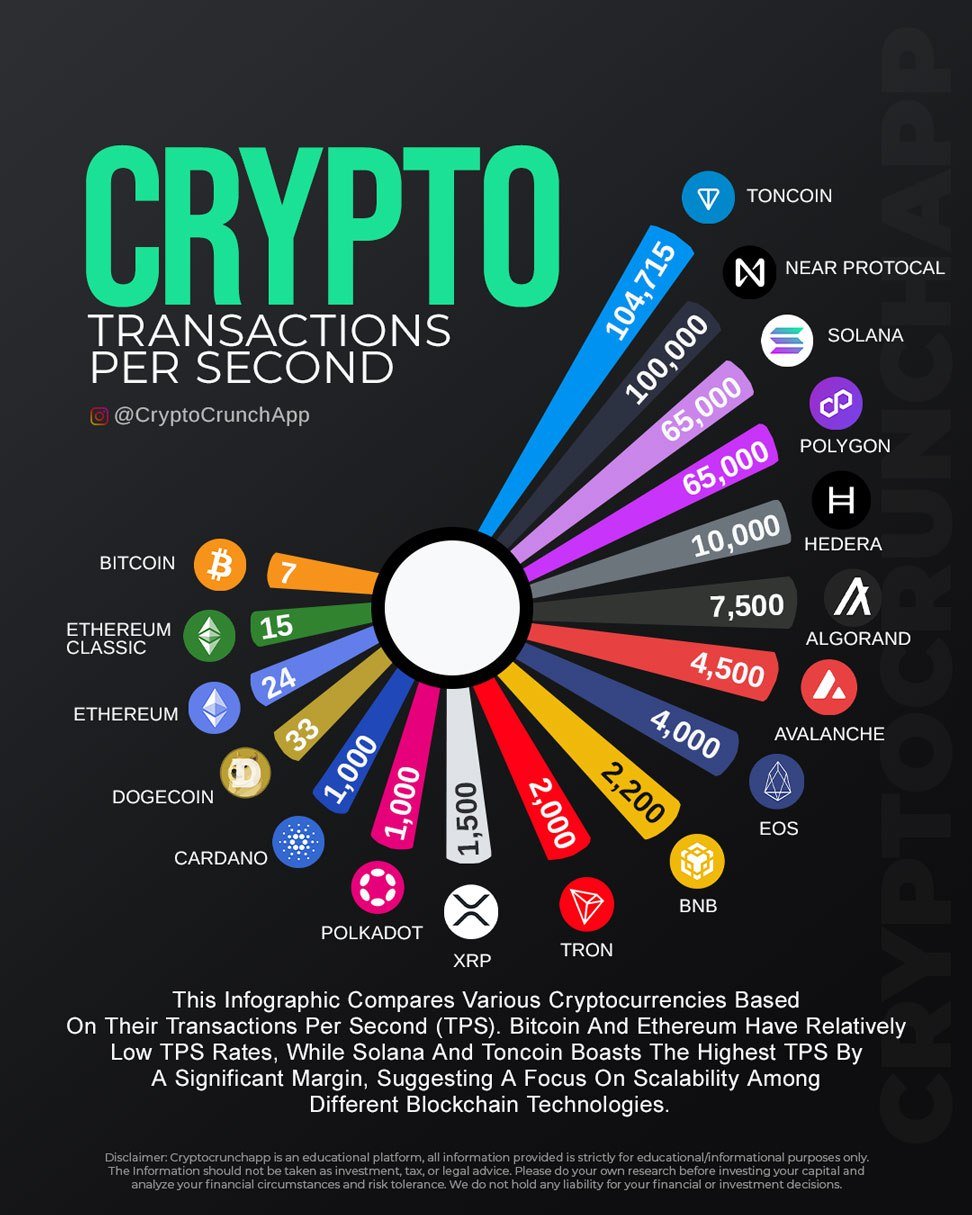
Top Crypto Transaction Speeds Unveiled: Ranking by Transactions Per Second

Explore the transaction speeds of popular cryptocurrencies measured in Transactions Per Second (TPS):

  • Toncoin: Leads with 104,775 TPS.
  • Near Protocol: Follows with 100,000 TPS.
  • Solana: Achieves 65,000 TPS.
  • Polygon: Processes 65,000 TPS.
  • Hedera: Matches with 10,000 TPS.
  • Algorand: Delivers 7,500 TPS.
  • Avalanche: Performs with 4,500 TPS.
  • EOS: Carries out 4,000 TPS.
  • TRON: Handles 2,000 TPS.
  • BNB: Manages 1,500 TPS.
  • Cardano: Conducts 1,000 TPS.
  • XRP: Offers 1,000 TPS.
  • Polkadot: Provides 1,000 TPS.
  • Ethereum: Runs 33 TPS.
  • Ethereum Classic: Supports 15 TPS.
  • Dogecoin: Facilitates 33 TPS.
  • Bitcoin: Has 7 TPS.

This concise list showcases the varying efficiencies of blockchain technologies in processing transactions, from the most to the least rapid.

PS: The #Bitcoin Lightning Network is capable of processing an impressive 1,000,000 transactions per second.

Bitcoin Inscription Number 76 Sells for $60,000 in Latest Sub-100 Ordinals Sale

BTC Inc., through its Ordinals-focused division Rare BTC, has brokered the sale of inscription number 76 for 1.7 BTC, which is equivalent to approximately $61,000 at the time of sale.

The sale is indicative of the active interest and perceived value in the Ordinals space, with Rare BTC positioning itself as a key player in the market for these distinctive bitcoin-based digital artifacts and unique satoshis.

The bitcoin ecosystem saw Ordinals generate a craze earlier this year, between May and June, with trading volume nearing that seen on Ethereum NFTs and leading to a spike in bitcoin fees. After a somewhat dull summer, Ordinals activity is back and already nearing the highs seen in May….

Read more on BitcoinMagazine

Everyone's Thinking About Second Layers Is Backwards

I have written quite a bit about my concerns regarding drivechains and miner incentives over the years, because I think it is a very important set of risks to be aware of. Bitcoin is almost 15 years old as a live network at this point, and it has stood up to a good bit of pressure and outright malicious griefing and attacks over those 15 years. Bitcoin has withstood internal attacks from developers trying to radically alter the system, it has withstood the same attack from most of the major businesses in the space, it has survived what could have been fatal and catastrophic bugs, super powers banning it, wild price volatility, etc. It has stood up to everything to date that has been…

Read more on BitcoinMagazine

How to manage crypto losses on tax returns in the US, UK and Canada

Cryptocurrency taxation is a subject of increasing importance, with governments worldwide working diligently to establish clear rules for taxing digital assets. In the United States, the United Kingdom, and Canada, crypto holders navigate complex regulatory landscapes, making it crucial to understand how crypto losses are taxed and their potential impact on tax liability. Whether new to crypto trading or with years of experience, reporting income and paying applicable taxes in compliance with local regulations is essential.

To comply with local cryptocurrency taxation laws, crypto holders must stay informed and compliant to avoid legal issues. This article examines the rules, deductions…

Read more on Cointelegraph

Pay and dump? How businesses accepting crypto payments influence adoption

Cryptocurrency enthusiasts often argue that businesses need to start accepting crypto as payments for adoption to grow — boosting usability and potentially creating strong demand for these currencies.

Some crypto communities often focus heavily on growing business adoption, with maps now compiling businesses worldwide that accept different cryptocurrencies as a payment method.

But if a business accepts cryptocurrency payments only to dump them on the market, it may undermine the entire effort, as the assets are just being sold back on the market right after payment.

Moreover, a business accepting cryptocurrency payments through a third-party processor isn’t adhering to the…

Read more on Cointelegraph

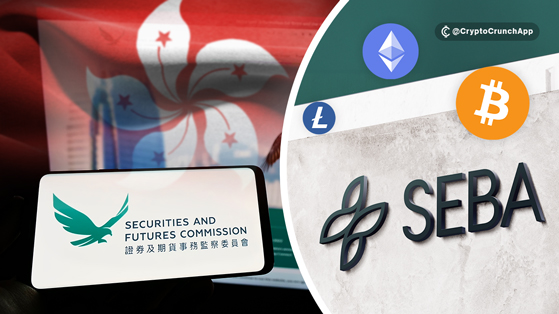
LATEST: Switzerland’s SEBA Bank Secures License for Crypto Services in Hong Kong

Switzerland’s SEBA Bank has secured a license from the Hong Kong Securities and Futures Commission (SFC), allowing its subsidiary, SEBA Hong Kong, to provide various crypto-related services in the region. The license covers securities, including digital asset products like OTC derivatives, marking SEBA’s entry into the Asia Pacific market. Additionally, SEBA can now offer advisory services on securities and digital assets, as well as asset management for discretionary accounts. This development enhances Hong Kong’s position in the global crypto economy, with the city’s stringent regulatory framework attracting only a select few crypto firms.

Polygon and Near are bringing zkWASM to life

Polygon Labs has partnered with the NEAR Foundation to bring zero-knowledge (zk) proving to WebAssembly (WASM) blockchains, the teams announced at NEARCON in Lisbon today. 

This means that developers who build with Polygon’s Chain Development Kit (CDK), an open-source codebase, will soon be able to use zkWASM as a prover.

In ZK technology, a prover refers to the party trying to show a claim is accurate to a verifier without revealing the information itself. A verifier is responsible for acknowledging that the information is accurate.

Having a zkWASM prover will enable NEAR layer-1 validators to simplify their proving process, as they will no longer need to work on verifying…

Read more on Blockworks

Champ Medici talks Web3 communities, NFTs, music and gaming

The Web3 industry has experienced massive growth over the last many years, from a niche that saw the glimpses of the future of the internet, to a reality building that future with the brightest minds and makers. 

The space has also received support from a number of influential people, absorbing big names originating from outside of Web3. One of those people is the world-famous rapper and entrepreneur Snoop Dogg and his son Cordell Broadus, also known as Champ Medici.

Over the last year in particular, Broadus and Snoop have been at the forefront of combining Web3 technologies like nonfungible tokens (NFTs), the metaverse and blockchain with the music industry and his large community.

In…

Read more on Cointelegraph

Decentralized AI platform Ritual lands $25M in seed funding

Decentralized AI platform Ritual came out of stealth after securing $25 million in a seed funding round led by Archetype. 

Accomplice and Robot Ventures also participated in the funding round. 

Ritual is the brainchild of Web3 investor Niraj Pant, who funded projects like EigenLayer and Solana, and Akilesh Potti, quant and then builder at data analytics company Palantir. 

Over the past year, AI companies have witnessed significant growth that offers new experiences, products and a new source of revenue, Pant said. Although this may be the case, there are also significant problems taking place.

“Models are owned and run on centralized APIs hosted by a few corporations, who are bad…

Read more on Blockworks