LidoDAO launches official version of wstETH on Base

Lido’s governing body has approved the deployment of Lido’s Wrapped Staked Ether (wstETH) to Coinbase’s Base network, according to a Nov. 8 announcement. The token is now live and can be traded or used in decentralized finance (DeFi) applications on the Base network.

Lido is on @BuildOnBase

You can now bridge your staked ETH to Base. pic.twitter.com/R9vN2XGs2g

— Lido (@LidoFinance) November 8, 2023

Lido is a liquid staking protocol that allows users to stake some cryptocurrencies while simultaneously using them in DeFi applications. It does this by issuing a derivative token that can be redeemed for the underlying staked one. 

In the case of Ethereum’s…

Read more on Cointelegraph
Notional Finance brings fixed-rate borrowing to Arbitrum

Notional Finance has made the jump from Ethereum mainnet to layer-2 with the third iteration of its fixed-rate borrowing and lending protocol.

The new v3 launched publicly on Monday after a month of closed beta testing. It expands beyond simple bitcoin, ether and stablecoin borrowing and lending to emphasize strategies that leverage yield.

An initial suite of leveraged vaults on Arbitrum enables users to borrow substantially against their initial capital. This amplifies their potential yield if the returns exceed the borrowing cost, while also minimizing liquidation risk.

Read more: Arbitrum DAO looking to bet $40M on network protocols

These vaults are designed for advanced DeFi users…

Read more on Blockworks

Stablecoins ‘not a safe store of value’: BIS

The Bank of International Settlements (BIS), a coalition of the world’s central banks, criticized stablecoins as being “not a safe store of value” in its latest research report dated Nov. 8.

In outlining its reasons, the BIS explained that from January 2019 to September 2023, fiat-backed stablecoins maintained their peg ratio only 94% of the time, less than the 100% often promised in projects’ whitepapers. Meanwhile, the peg ratio for crypto-backed and commodity-backed stablecoins was far less at 77% and 50%, respectively.

“Only seven fiat backed stablecoins have been able to keep their deviations from the peg below 1% for more than 97% of their life span,” BIS wrote. Both Tether (USDT)…

Read more on Cointelegraph

European Banking Authority has new rules for stablecoin issuer recovery plans

The European Banking Authority released draft guidelines for stablecoin issuers Wednesday, per a mandate under the recently passed Markets in Crypto-Assets Regulation (MiCA) policy. 

In its proposal, the EBA outlines how issuers of stablecoins — which the regulator refers to as asset-reference tokens (ARTs) — and other cryptocurrencies should structure their risk management and recovery plans. 

“All issuers should include a de-pegging risk indicator, aimed to keep track of the alignment between the market price of the token and the market value of the referenced asset,” the draft reads. 

The regulator stipulated that in response to “adverse scenarios” potentially…

Read more on Blockworks

Visa launches global AI advisory practice focused on generative systems

Visa announced the launch of its new global AI advisory practice on Nov. 8. The consultation service will be part of Visa Consulting & Analytics (VCA) and, according to a press release, will focus on “providing actionable insights and recommendations to empower clients to unlock the potential of AI and utilize generative AI.”

Citing its “30-year AI legacy,” Visa announced the new practice alongside a range of new services related to empowering clients to understand the potential role of generative AI at the enterprise level.

The service will be tended by VCA’s global network of “over 1,000 consultants, data scientists and…

Read more on Cointelegraph

New BTC price levels to watch as Bitcoin avoids $36K

Bitcoin (BTC) has new short-term BTC price targets as consolidation mixes with bouts of volatility.

After a classic “short squeeze” took the largest cryptocurrency to near $36,000, Bitcoin market participants are highlighting key levels to look for from Nov. 8 onward.

Bitcoin buy liquidity inches down to $34,000

Bitcoin is facing hurdles overcoming resistance at the $36,000 mark, and several attempts to clear it have quickly faded data from Cointelegraph Markets Pro and TradingView shows.

Now, sellers are becoming active on intraday timeframes, and data from exchange order books shows the buy side getting cautious.

In an X post on the day, on-chain monitoring resource Material Indicators…

Read more on Cointelegraph

Ethereum’s Justin Drake is unconcerned despite ether’s middling year: Q&A

When Ethereum’s “Merge” to proof-of-stake went off without a hitch last September, some felt the layer-1 was primed for a breakout. Speculation arose around a “flippening” and institutional investors waited in the wings.

But ether’s price did not end up meeting these expectations. NFTs tested new lows, and the bear market muted DeFi engagement. Bitcoin continued to outpace ether in 2023 — recently reaching dominance levels not seen since 2021. Meanwhile, institutional inflows are largely yet to materialize. 

Blockworks spoke with Justin Drake, a researcher at the Ethereum Foundation, about the network’s current standing and future prospects. Keep reading for more…

Read more on Blockworks

Polygon Labs and NEAR announce ZK prover for WASM integration

The developers of the NEAR and Polygon networks are teaming up to create a zero-knowledge (ZK) prover for Web Assembly (WASM) blockchains, according to a joint announcement on Nov. 8. The new prover, called “zkWASM,” will for the first time allow WASM-based networks to join the Polygon ecosystem.

Zero-knowledge, meet Web Assembly.

The NEAR Foundation and @0xPolygonLabs are set to deliver the future of zero-knowledge for WASM based blockchains with zkWASM.

Empowering greater security, scalability, developer flexibility, and interoperability in the open web

zkWASM will… pic.twitter.com/D1BIztjMI9

— NEAR Protocol | NEARCON | November 7-10 | Lisbon! (@NEARProtocol)… Read more on Cointelegraph

Bitcoin Beyond BIP-300: What Future Holds For ‘DeFi On BTC’

Does Bitcoin need any sidechains for its future? The DeFi community nowadays is split between “yes” and “no” as an answer to this question after the resurgence of a six-year-old proposal. Since the controversy around sidechains involves advanced crypto language, let’s cover the basics first and then take a deeper look into the pros and cons of the proposal as well as any potential solutions.

Before we delve into the specifics of BIP-300, it’s worth mentioning that there are alternative approaches to expanding Bitcoin’s utility that don’t involve sidechains. One such approach is merged mining, which allows Bitcoin’s Proof-of-Work (PoW) to be shared with more chains at no extra…

Read more on BitcoinMagazine

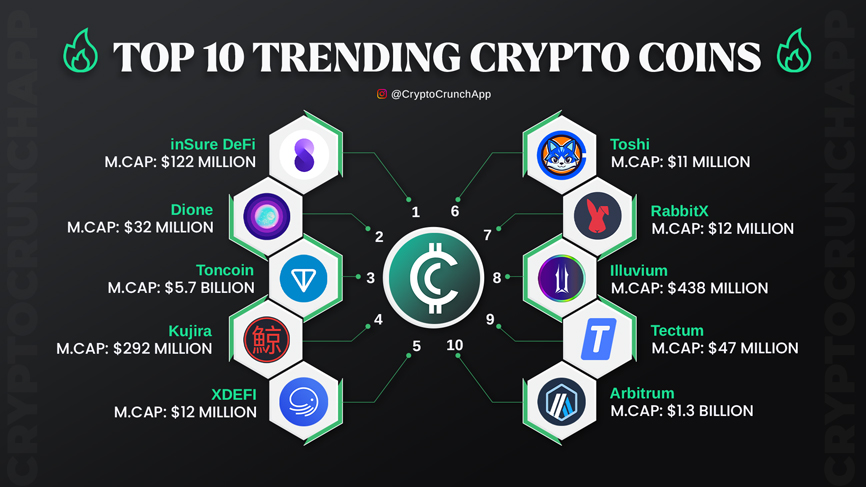
Top 10 Trending Crypto Coins of The Day

  1. inSure DeFi: Market Cap of $122 Million.
  2. Dione: Market Cap of $32 Million.
  3. Toncoin: Market Cap of $5.7 Billion.
  4. Kujira: Market Cap of $292 Million.
  5. XDEFI: Market Cap of $12 Million.
  6. Toshi: Market Cap of $11 Million.
  7. RabbitX: Market Cap of $12 Million.
  8. Illuvium: Market Cap of $438 Million.
  9. Tectum: Market Cap of $47 Million.
  10. Arbitrum: Market Cap of $1.3 Billion.

Disclaimer: Market capitalizations can vary in real-time. The information provided here is intended purely for educational purposes and should not, under any circumstances, be construed as financial advice.