Transaction URL: https://blockchain.com/btc/tx/aee8392c2ae96aeddd5c9802c6475501ccd7cc8b5bcb53b6f4d608c6ea5f72f5

- Crunch
- Global

The global landscape of cryptocurrency wealth has seen significant growth, particularly in Bitcoin holdings. As of June 2024, over 85,400 individuals have amassed over $1 million solely from Bitcoin, marking an impressive annual growth rate of 111%. This surge is part of a broader increase across all cryptocurrencies, with total crypto users worldwide reaching 560 million, up by 32% from the previous year.
Bitcoin’s remarkable performance also reflects in the total market value of cryptocurrencies, which has reached $1.2 trillion, indicating a growth of 103% within a year. This financial expansion outpaces the general crypto market, which also grew by 89% to a total value of $2.3 trillion. The number of Bitcoin millionaires and centi-millionaires has notably doubled, underscoring Bitcoin’s significant impact on individual wealth.
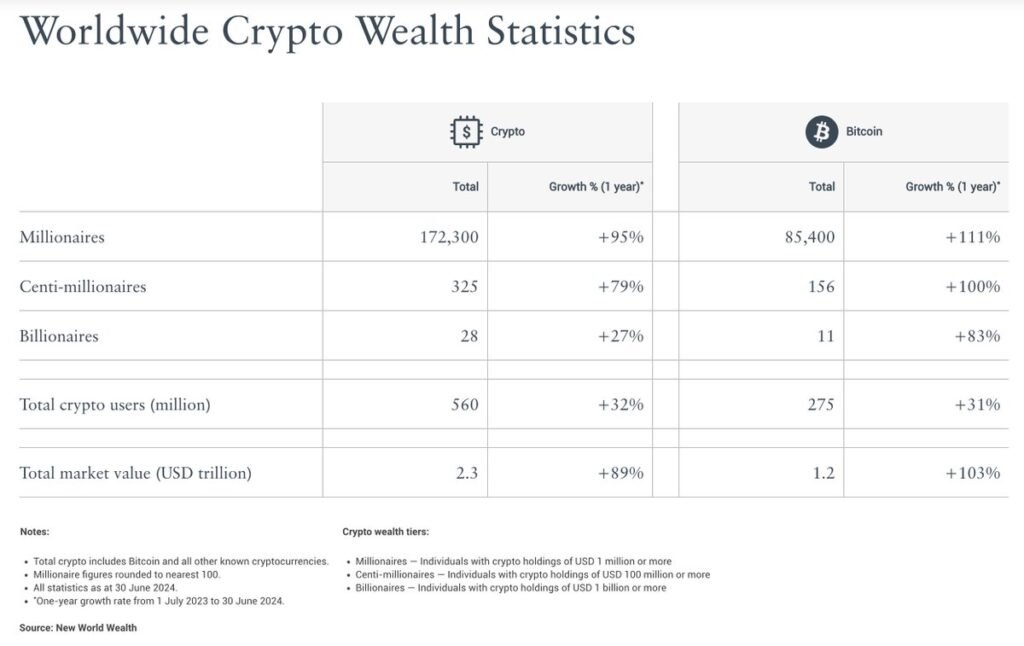
These statistics reveal not only the rising adoption of cryptocurrencies but also highlight their increasing influence on global wealth distribution. With Bitcoin leading the way, the digital currency market continues to offer substantial opportunities for wealth accumulation, attracting more users and investors into the sphere.
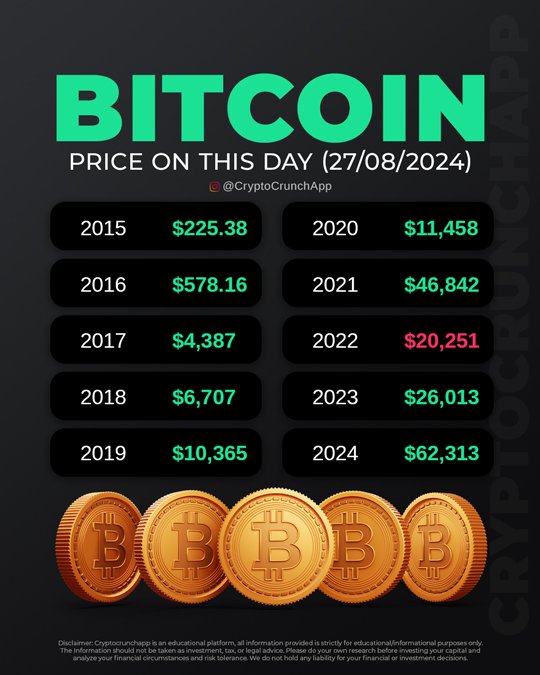
Over the past decade, Bitcoin has seen a dramatic rise in its price, reflecting its journey from a little-known digital asset to a major force in the financial world. In 2015, Bitcoin was valued at $225.38, a modest amount showing its early stage of adoption. By 2016, the price had more than doubled to $578.16 as more investors became interested.
In 2017, Bitcoin’s price soared to $4,387 during a major cryptocurrency boom, but by 2018, it settled at $6,707. Despite some ups and downs, Bitcoin continued to grow, reaching $10,365 in 2019 and $11,458 in 2020, even in the face of global economic challenges.
By 2021, Bitcoin hit $46,842, driven by large-scale investments and wider acceptance. Although the price dropped to $20,251 in 2022, it bounced back to $26,013 in 2023 and then skyrocketed to $62,313 in 2024. This ten-year journey shows Bitcoin’s volatility but also its strength and growing role in finance.
Disclaimer: Market capitalizations and data can vary in real-time. The information provided here is intended purely for educational purposes and should not, under any circumstances, be construed as financial advice.
Join CryptoCrunchApp on Telegram Channels – Click to Join

BlackRock has significantly increased its Bitcoin investments, now holding 16,000 shares of the iShares Bitcoin Trust (IBIT) as of June 30, 2024, reflecting a substantial addition of 4,000 shares since May. This update showcases BlackRock’s deepening confidence in Bitcoin and marks a progressive stance towards integrating cryptocurrency into its diverse portfolio of global investments.
The move aligns with a broader trend where financial giants are progressively incorporating Bitcoin ETFs into their strategies. With institutional investors expanding their crypto footprint, BlackRock’s decision underscores a global shift towards embracing digital assets. This development is echoed in markets worldwide, including significant growth in Bitcoin ETF assets in Hong Kong, suggesting a robust, international appetite for regulated cryptocurrency investments.
As BlackRock enhances its exposure to digital currencies within its Strategic Global Bond Fund, this shift points to a strategic recognition of Bitcoin’s potential to diversify portfolios and provide a hedge against traditional market volatilities. This growing institutional endorsement could signal a new era of investment dynamics across the financial landscape.

Argentina’s Ministry of Education has teamed up with the ETH Kipu Foundation to bring Ethereum and blockchain technology into the curriculum of Buenos Aires high schools. Starting August 27, the initiative aims to position Argentina as a leader in the tech-driven economy, outpacing other Latin American nations in blockchain education and adoption. Paula D., co-founder of ETH Kipu, highlighted the program’s potential to forge new career paths and advance Argentina’s role in the global blockchain sphere.
The program includes opportunities for high school students to engage in internships with blockchain projects and offers an online Solidity course for students over 18, designed to equip them with skills to develop decentralized applications (dApps). Additionally, 30 local educators will be trained to teach these cutting-edge topics, with plans to expand the educational framework regionally.
This educational push aligns with a global trend towards integrating blockchain technology into learning curriculums. Similar initiatives by organizations like Tether and countries like El Salvador underscore the growing importance of blockchain knowledge in preparing for a digital future.
At the time of writing, Bitcoin is currently valued at $63,500, deemed a fair market price according to the Bitcoin Cycle Master chart and data from Bitcoin Magazine Pro. The Bitcoin Cycle Master chart integrates on-chain metrics, including Coin Value Days Destroyed and Terminal Price, to assess Bitcoin’s position within its economic cycles. Historically, these cycles occur approximately every four years, aligning with Bitcoin halving events.
The Bitcoin Cycle Master tool analyzes actual economic behavior on the Bitcoin blockchain to determine whether Bitcoin is…
Read more on BitcoinMagazine