Transaction URL: https://tronscan.org/#/transaction/454612565be5c7aa47cc54c992eb4efce258393c3444fb5225d561fb859eccc7

- Crunch
- Global
This article is featured in Bitcoin Magazine’s “The Halving Issue”. Click here to get your copy.
Every morning at 6am, in Punxsutawney, Pennsylvania, the cynic weatherman Phil Connors wakes up to experience the same day over and over and over again. Stuck in a time loop, Connors tries everything to get his life back to normal – he gets stabbed, shot, burned, frozen and electrocuted, only to wake up again the next day as if nothing had happened. Connors quickly comes to the only plausible conclusion: he must be a god.
Thinking ourselves to be undefeatable has never been a particularly smart strategy, in times of war or otherwise. If we believe in cosmology, from Nietzsche to…
Read more on BitcoinMagazine
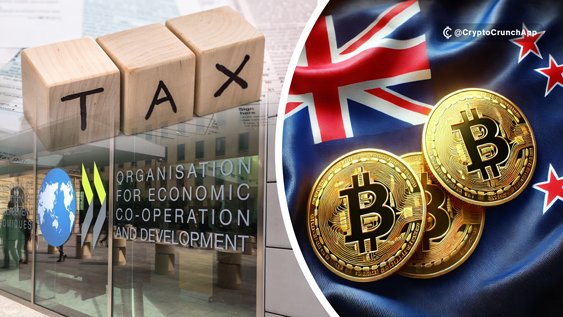
New Zealand is set to implement the OECD’s crypto reporting framework by April 2026, aiming to enhance transparency and combat international tax evasion. As outlined in a recent policy document, the Taxation (Annual Rates for 2024–25, Emergency Response, and Remedial Measures) Bill introduced by Minister of Revenue Simon Watts supports this initiative. The framework, approved by the OECD in 2022, mandates firms to provide detailed tax information on crypto asset transactions.
Starting April 1, 2026, local crypto-asset service providers will be required to gather data on users’ transactions. This move is designed to streamline the exchange of information and support global efforts against tax evasion. The framework’s adoption demonstrates New Zealand’s commitment to aligning with international standards in financial transparency.
By June 30, 2027, firms will need to report this transaction information to the Inland Revenue. This progressive step not only supports global financial integrity but also positions New Zealand as a leader in responsible crypto regulation.
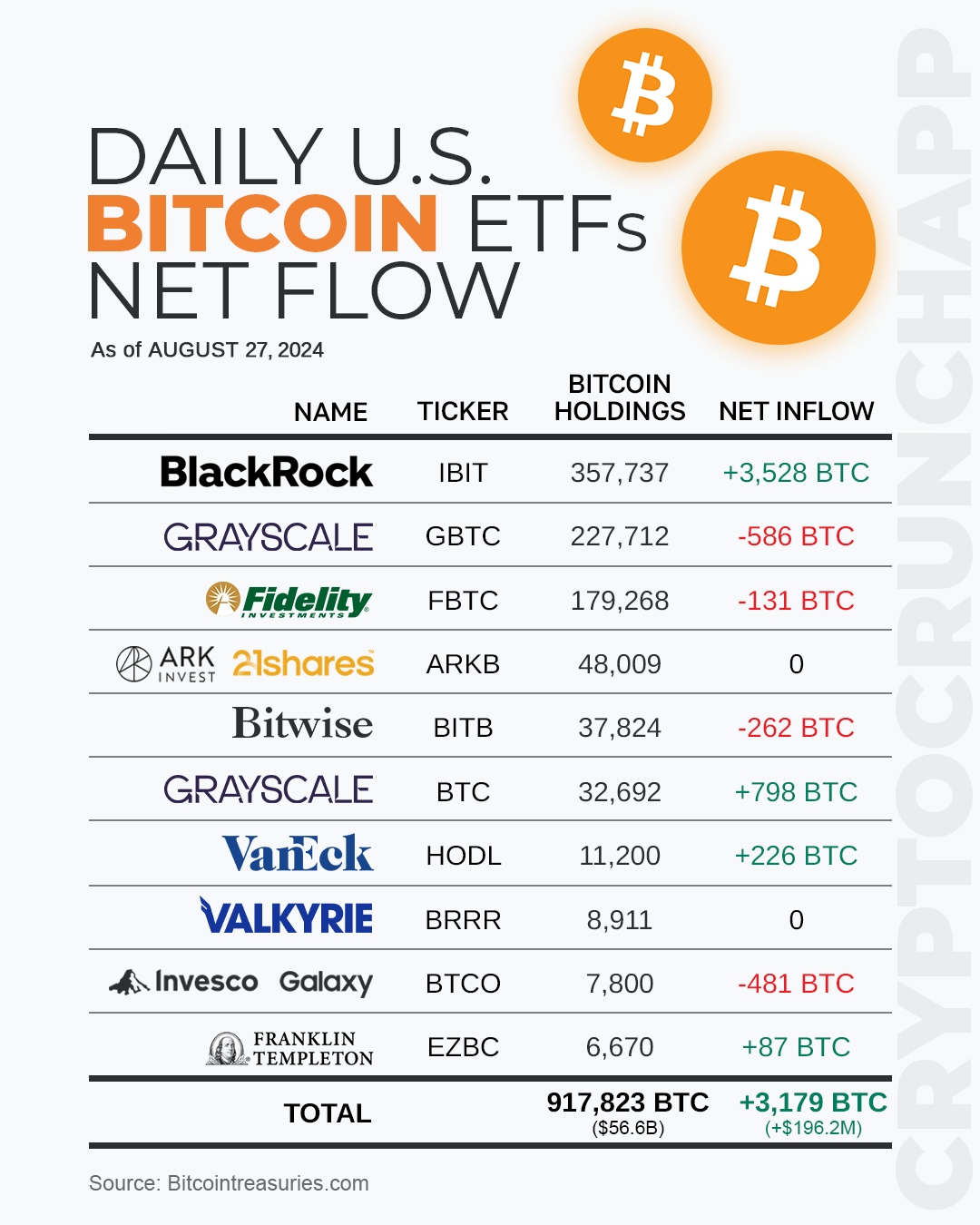
On August 27, 2024, there was significant activity in U.S. Bitcoin ETFs, reflecting strong investor interest. BlackRock’s IBIT ETF stood out with a large net inflow of 3,528 BTC, bringing its total holdings to 357,737 BTC. This suggests that investors are confident in BlackRock’s Bitcoin strategy.
On the other hand, Grayscale’s GBTC saw a net outflow of 586 BTC, reducing its total to 227,712 BTC. This could indicate some investors are being cautious or taking profits. Fidelity’s FBTC and Invesco Galaxy’s BTCO also had net outflows of 131 BTC and 481 BTC, respectively, pointing to similar trends.
Meanwhile, smaller ETFs like Valkyrie’s BRRR and Franklin Templeton’s EZBC remained stable, with Franklin Templeton even adding 87 BTC. However, Bitwise’s BITB faced a net reduction of 262 BTC.
Overall, the total Bitcoin held by all U.S. ETFs reached 917,823 BTC, with a collective net inflow of 3,179 BTC. This led to an increase in value of about $196.2 million for the day. This snapshot gives us a good idea of how investors are feeling about these Bitcoin investment funds.
Disclaimer: Market capitalizations and data can vary in real-time. The information provided here is intended purely for educational purposes and should not, under any circumstances, be construed as financial advice.
Join CryptoCrunchApp on Telegram Channels – Click to Join

In the rapidly expanding global Bitcoin community, Western biases often dominate the narrative, overlooking diverse stories from around the world. One such story belongs to Didier Somnuke, a small business owner in the heart of Bangkok, a city known for welcoming 22.8 million international tourists in 2023, surpassing cities like Paris, London, and New York City. Although Thailand has experienced a massive spike in household debt, reaching 16.37 trillion baht (US$463 billion) or 90.8% of the national GDP, up from less than 14 trillion baht in 2019.
Didier Somnuke, born in Yala province, where geopolitical conflict is a harsh reality. Southern Thailand is one of the poorest parts of…
Read more on BitcoinMagazine
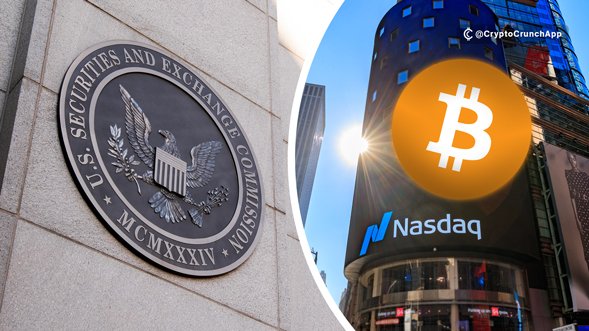
Nasdaq has announced plans to seek regulatory approval for trading options on a bitcoin index, marking a significant move towards mainstream acceptance of cryptocurrency derivatives. The U.S. Securities and Exchange Commission (SEC) has not yet approved any options linked to bitcoin ETFs that launched earlier this year, including Nasdaq’s bid to trade options on BlackRock’s iShares Bitcoin Trust ETF. The new index options aim to provide institutional investors with cost-effective tools to manage bitcoin exposure and enhance liquidity.
Matt Hougan, chief investment officer at Bitwise, emphasized the importance of bitcoin options, stating that for cryptocurrencies to become a normalized asset class, such options are essential. Options are financial instruments that allow investors to speculate on price movements or hedge against them, offering a strategic approach to investment in volatile markets like cryptocurrencies.
As the crypto community awaits the SEC’s decision, the introduction of these bitcoin index options by Nasdaq could potentially reshape the landscape for institutional and retail investors, providing more avenues for investment and risk management in the evolving digital asset space.

Hilbert Capital, a division of Hilbert Group AB, has entered into a significant partnership with Xapo Bank to manage a new Bitcoin hedge fund, according to a press release sent to Bitcoin Magazine.
The fund is expected to receive over $200 million in initial investment capital from Xapo Bank and other investors, according to the release. This initiative is being launched to allow corporates, businesses, and professional investors the option to generate returns in Bitcoin through institutional-grade structured credit arrangements.
“We believe that offering the right products for participants in the space who are aiming not only for exposure to the Bitcoin price, but also structured ways…
Read more on BitcoinMagazine