Transaction URL: https://blockchain.com/btc/tx/393c5648a1ee6477a373fdb9dcd75c152636ccbafe40a6faa710d6dd697dd7f2

- Crunch
- Global
Leading cryptocurrencies surged Monday as investors piled into the segment ahead of the release of key inflation data.
CryptocurrencyGains +/-Price (Recorded 9:30 p.m. EDT)Bitcoin BTC/USD+2.09%$59,643.06Ethereum ETH/USD +6.78%$2,714.34Dogecoin DOGE/USD +5.88%$0.1076
What Happened: Bitcoin spiked above $60,000 in early trading hours, followed by a seesaw movement within the $58,500 and $59,700 range. Leading Bitcoin mining company Marathon Digital Holdings Inc. MARA announced plans to raise $250 million more to acquire Bitcoin through a new debt offering.
Ethereum breached $2,700, reaching its highest level since last week’s Monday…
Read more on Benzinga

A recent poll by investment firm Paradigm indicates a growing interest in cryptocurrency among Democrats, with 18% of Democratic voters having already invested in crypto. The survey also highlights that 9% of Democrats are “very likely” to invest in the coming year, while another 18% are “somewhat likely.” However, a significant portion, 54%, remain hesitant, stating they are “not at all likely” to invest.
The poll underscores the potential impact of crypto on the upcoming presidential election, especially among those holding larger amounts. Notably, 33% of Democrats with over $10,000 in crypto see it as a crucial voting issue, reflecting the industry’s increasing political influence.
Crypto’s appeal is particularly strong among Democratic voters of color. The poll found that 22% of Black Democrats, 25% of Hispanic Democrats, and 27% of AAPI Democrats have invested in crypto, indicating a significant demographic shift in support for digital assets.
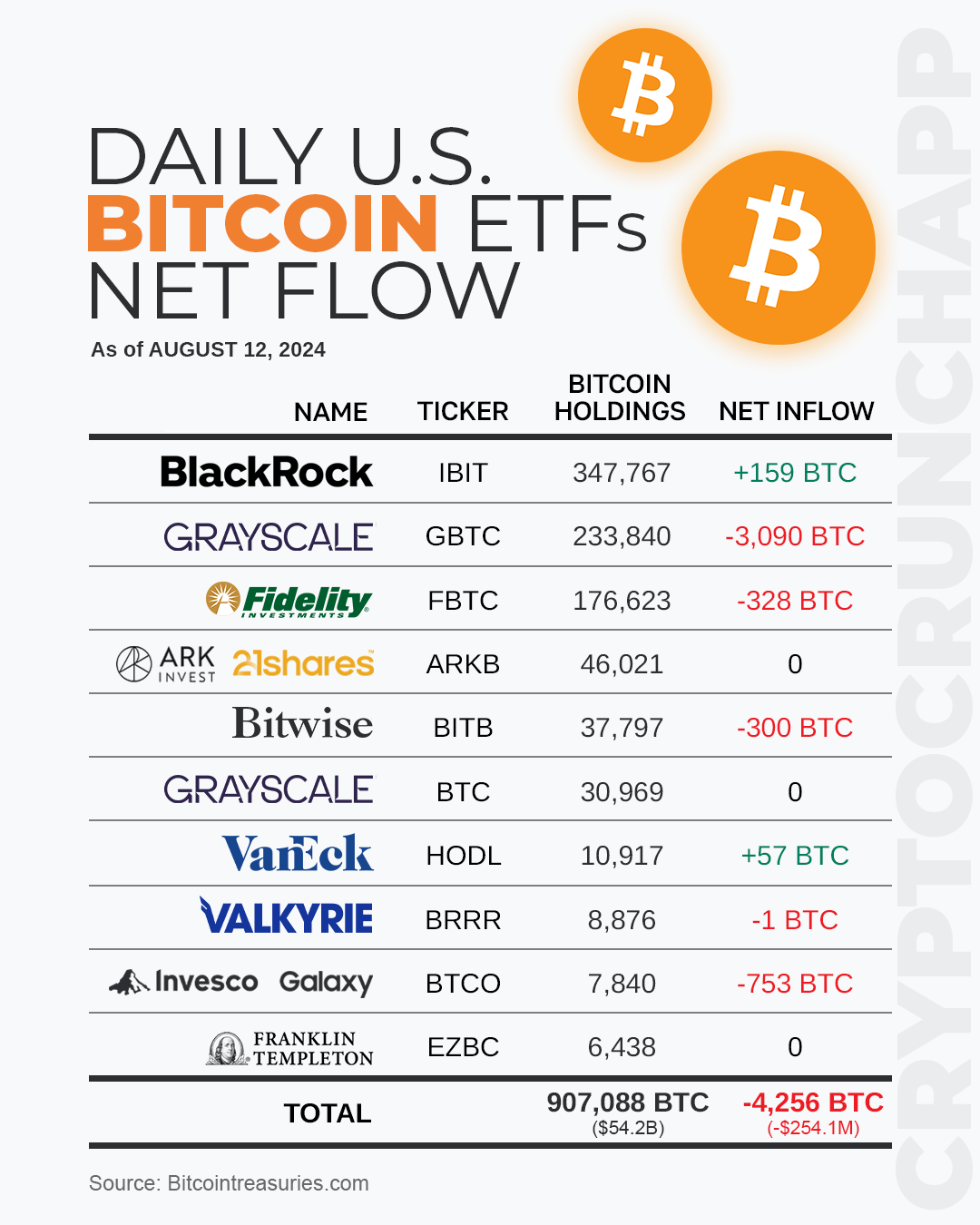
On August 12, 2024, the daily net flow of Bitcoin across U.S. ETFs demonstrated significant trading activity with a mixed impact across different funds. BlackRock’s IBIT ETF experienced the largest net inflow of +159 BTC, increasing its holdings to 347,767 BTC. In contrast, Grayscale’s GBTC saw a substantial net outflow of -3,090 BTC, reducing its holdings to 233,840 BTC.
Fidelity’s FBTC and Bitwise’s BITB also reported net outflows of -328 BTC and -300 BTC respectively. Invesco Galaxy’s BTCO observed a notable outflow of -753 BTC. However, VanEck’s HODL ETF showed some positive movement with a net inflow of +57 BTC. Valkyrie’s BRRR had a minimal change with -1 BTC.
Overall, the total Bitcoin holdings across all listed U.S. ETFs stood at 907,088 BTC, with a net daily outflow of -4,256 BTC, equivalent to a value decrease of approximately $254.1 million. This data illustrates the dynamic and varying investor sentiment and trading strategies within the U.S. Bitcoin ETF market on that day.
Disclaimer: Market capitalizations and data can vary in real-time. The information provided here is intended purely for educational purposes and should not, under any circumstances, be construed as financial advice.
Join CryptoCrunchApp on Telegram Channels – Click to Join
The dynamics of memecoin trading are coming to NFT markets.
Zora announced the launch of onchain secondary markets with Uniswap for its NFT collectibles last week.
This is enabled by a new “ERC-20z” token standard, an extension from the ERC-1155 standard that effectively wraps and unwraps an NFT so it becomes tradable like a standard ERC-20 token.
Zora’s new token standard addresses a typical pain point of NFT mints, namely the lack of liquidity to make NFTs tradable on a secondary marketplace after the mint closes.
Read more: Web3 Watch: A second Trump token fiasco
To bootstrap initial liquidity, the new token standard funnels a portion of mint fees into the subsequent Uniswap…
Read more on Blockworks
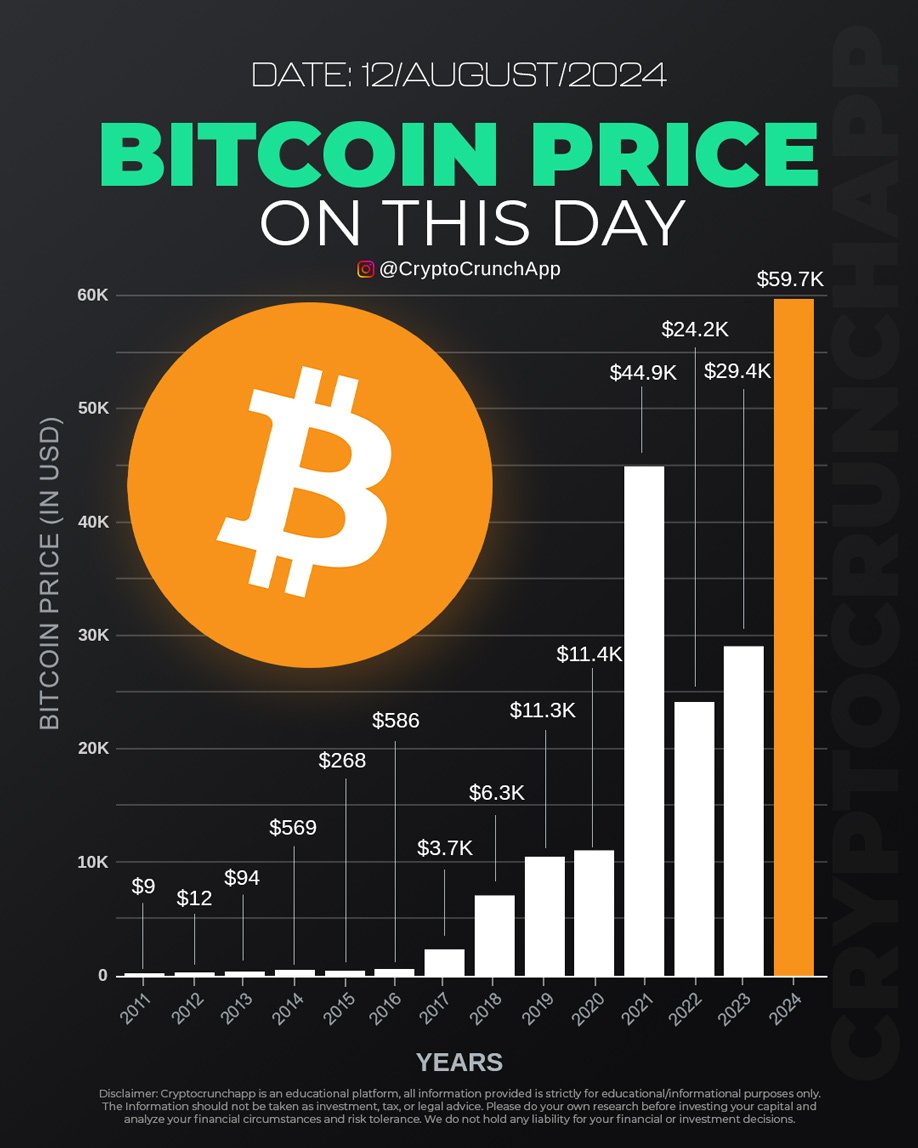
Bitcoin’s price on August 12 each year from 2001 to 2024 showcases its dramatic fluctuations and overall growth trajectory. The data reveals how Bitcoin’s market value has evolved, with significant yearly changes indicating its volatile nature.
In 2024, Bitcoin reached a notable price of $59.7K on this date. This was a substantial increase compared to $29.4K in 2023 and $11.4K in 2022. The price progression each year provides a clear view of how Bitcoin has appreciated over time, moving from just $9 in 2001 to several thousand dollars in recent years.
By 2017, the price consistently exceeded $1K, hitting $3.7K, and by 2021, it had soared to $44.9K. The price trends over these years highlight significant growth phases interspersed with corrections, reflecting shifts in investor sentiment and broader economic factors affecting the cryptocurrency market.
Disclaimer: Market capitalizations and data can vary in real-time. The information provided here is intended purely for educational purposes and should not, under any circumstances, be construed as financial advice.
Join CryptoCrunchApp on Telegram Channels – Click to Join

“Give me liberty, or give me death!” Ben James said, poking the air with his fork to emphasize. I smiled back at my husband as he enjoyed the steak I’d grilled in the backyard. He was telling me about the second Citadel he wanted to create, this one affiliated with us, run like ours, but on Mars. We had enough wealth from his father’s early Bitcoin purchases to create multiple cities if we wanted to. And Ben James wanted to.
I looked over at our daughter, Marla, dutifully whipping up sandwiches for her brothers before they came home; she was beautiful, the sun shining behind her long hair as a breeze blew through our kitchen windows and gently rustled her sundress in the hot summer…
Read more on BitcoinMagazine

Amid a recent downturn, digital asset investment products experienced a significant influx of funds, totaling $176 million. This surge is viewed by many as a strategic move to capitalize on lower prices. Notably, Ethereum led the gains, drawing $155 million in new investments. The market’s resilience is further highlighted by the recovery of total Assets Under Management (AUM) from $75 billion to $85 billion after a $20 billion correction.
Investment activity in exchange-traded products (ETPs) spiked, with transactions reaching $19 billion over the week, substantially above the yearly average of $14 billion. All regions, including the US, Switzerland, Brazil, and Canada, reported positive inflows, underscoring a global consensus on the asset class’s potential post-correction.
Additionally, Bitcoin’s dynamics shifted as the week progressed, culminating in $13 million in inflows. Conversely, Short Bitcoin ETPs witnessed their most significant outflows since May 2023, indicating a decrease in bearish sentiment among investors. This pivot away from short positions suggests a broader confidence in the market’s future trajectory.