LATEST: Franklin Templeton Registers S-1 for New Bitcoin And Ether Crypto Index ETF

Franklin Templeton has taken a significant step toward expanding its digital asset offerings by filing an S-1 application with the US Securities and Exchange Commission (SEC) to launch the “Franklin Crypto Index ETF.” This proposed ETF aims to provide investors with regulated exposure to the performance of Bitcoin and Ethereum. The fund will track the CF Institutional Digital Asset Index, with Coinbase Custody Trust Company as the custodian for digital assets and Bank of New York Mellon handling cash management.

The ETF, if approved, will trade on the Cboe BZX Exchange under the ticker symbol “EZPZ.” The Cboe is also seeking regulatory approval for in-kind creation and redemption of ETF shares using digital assets, reflecting the increasing demand for innovative crypto investment products.

This filing underscores the growing competition among asset managers to enter the crypto space. With similar applications from Hashdex and Grayscale, the race to launch crypto ETFs highlights the rising institutional interest in digital assets despite market volatility.


SEC filing

Are Bitcoin Whales Buying The Dip?

Bitcoin’s recent price volatility has led many to wonder if large-scale bitcoin hodlers are taking advantage of price dips to accumulate more bitcoin. While some metrics may initially suggest an increase in long-term holdings, a closer examination reveals a more nuanced story, especially after the current prolonged period of choppy consolidation.

Are Long-Term Holders Accumulating?

Upon initial observation, long-term Bitcoin holders are seemingly increasing their holdings. According to the Long Term Holder Supply, since July 30th, the amount of BTC held by long-term holders has increased from 14.86 million to 15.36 million BTC. This surge of around 500,000 BTC has led some to believe that…

Read more on BitcoinMagazine

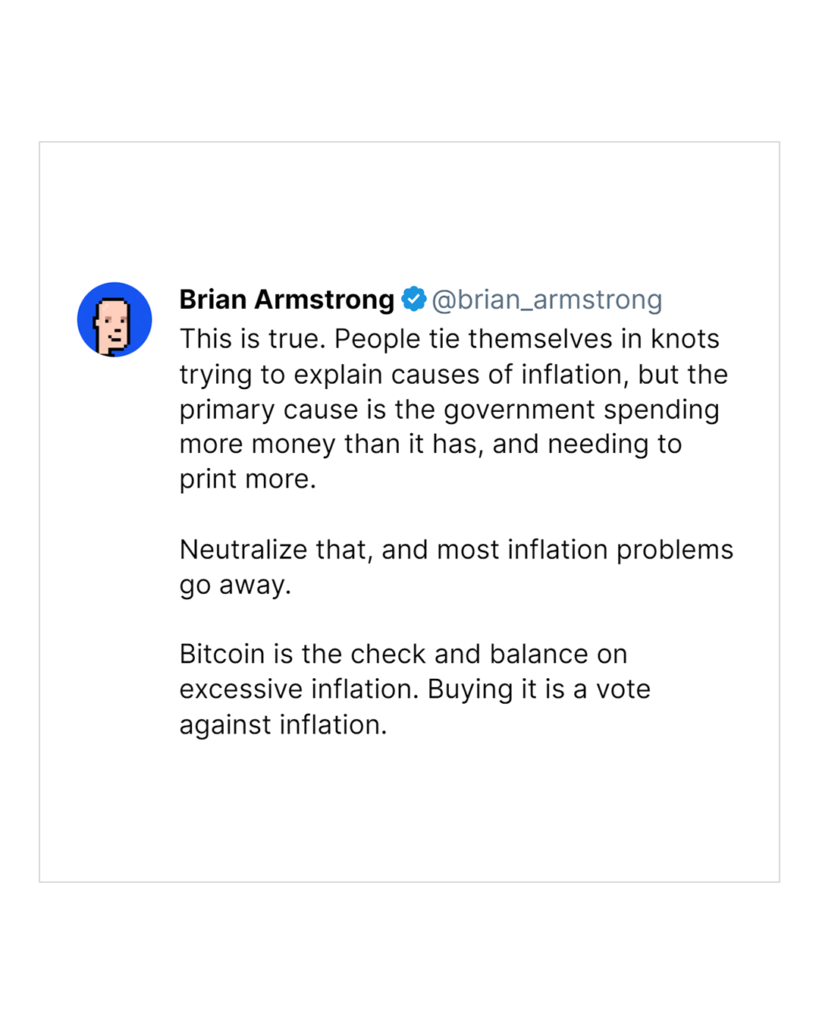
LATEST: Bitcoin as a Hedge Against Inflation, Say Brian Armstrong

Brian Armstrong, CEO of Coinbase, recently shared his thoughts on inflation, aligning with Elon Musk’s perspective that the primary cause is government overspending and the subsequent need to print more money. Armstrong emphasized that addressing this issue would resolve most inflation problems.

He went further to advocate for Bitcoin as a solution, describing it as a check and balance on excessive inflation. According to Armstrong, buying Bitcoin represents a vote against inflation, offering a way for individuals to protect their wealth from the devaluation of traditional currencies.

This stance underscores a growing belief in the financial community that cryptocurrencies like Bitcoin can serve as a hedge against economic instability, particularly in times of rising inflation.

The story behind Solana’s queen of cringe

Today, enjoy the Lightspeed newsletter on Blockworks.co. Tomorrow, get the news delivered directly to your inbox. Subscribe to the Lightspeed newsletter.

Howdy! 

We’re trying something a little different today and diving into the world of Solana-centric content creation. 

I had a fun time getting the inside scoop from bangerz, whose videos I’ve cringed at from afar for some time now:

The story behind Solana’s queen of cringe

The Solana Saga was in-demand in January 2024 as speculators sought to cash in on airdropped tokens that came with the device. Bangerz, a pseudonymous X creator who works at a Solana NFT startup, decided to fake a video of herself microwaving her Saga…

Read more on Blockworks

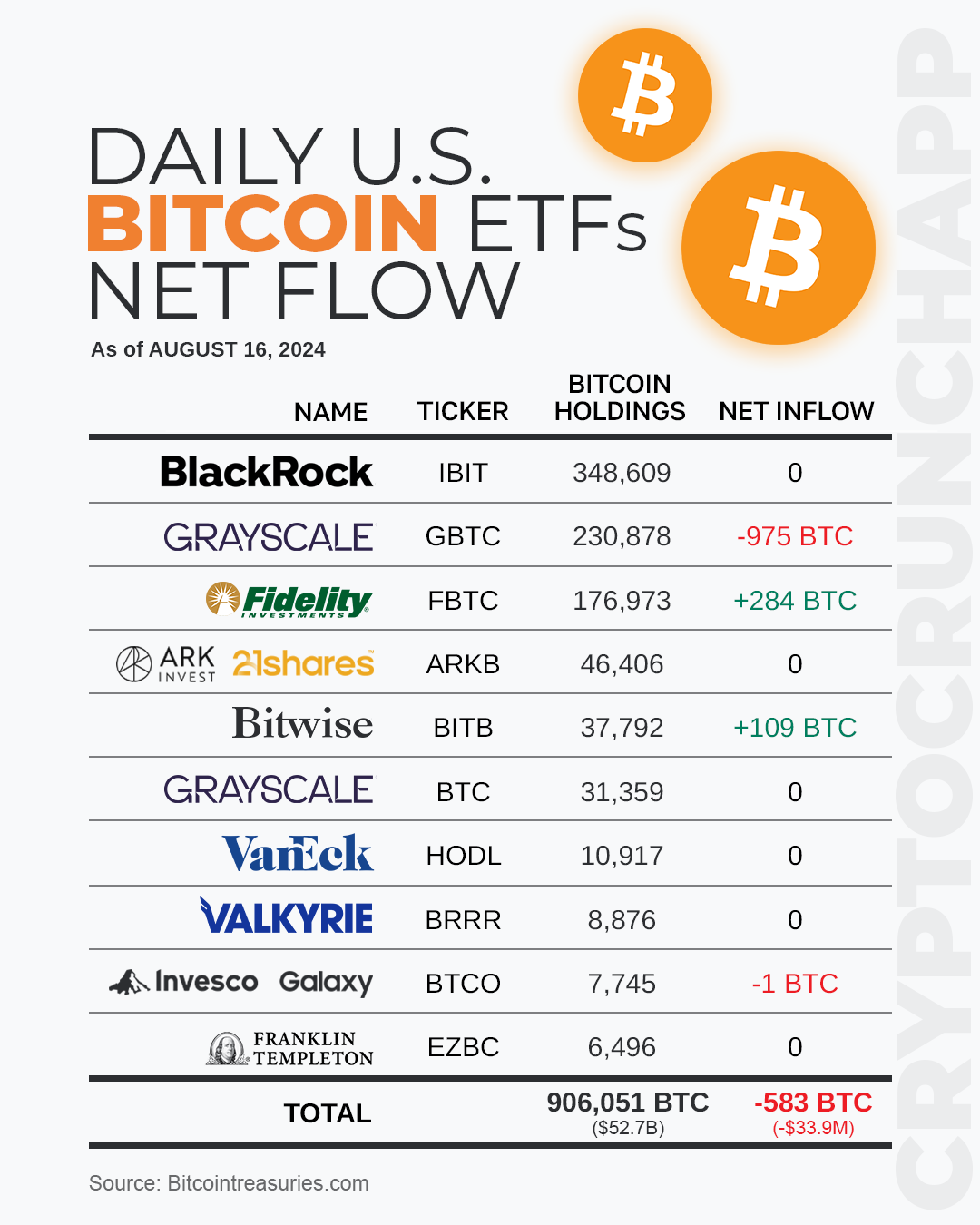
Daily US Bitcoin ETFs Net Flow Analysis (As of August 16, 2024)

The daily movements in the U.S. Bitcoin ETF market on August 16, 2024, reveal significant shifts in Bitcoin allocations among key players. Grayscale’s GBTC experienced a substantial net outflow of 975 BTC, significantly reducing its holdings to 230,878 BTC, indicating a major sell-off or reallocation within their strategy.

Conversely, Fidelity’s FBTC saw a positive influx, adding 284 BTC to its reserves, which now total 176,973 BTC, suggesting increased investor confidence or strategic accumulation within this fund. Bitwise’s BITB also reported a net positive flow, with an increase of 109 BTC.

Other major funds like BlackRock’s IBIT and ARK Invest’s ARKB maintained a stable position with no net inflow or outflow recorded on this day. Similarly, several smaller funds like Valkyrie’s BRRR, VanEck’s HODL, and Franklin Templeton’s EZBC showed no change in their Bitcoin holdings.

Overall, the total net flow across all U.S. Bitcoin ETFs was a decrease of 583 BTC, bringing the total holdings to 906,051 BTC, valued at approximately $52.7 billion. This net reduction reflects a dynamic and responsive ETF market responding to external market conditions or internal strategic decisions.

Disclaimer: Market capitalizations and data can vary in real-time. The information provided here is intended purely for educational purposes and should not, under any circumstances, be construed as financial advice.

Join CryptoCrunchApp on Telegram Channels – Click to Join

Institutional Inflows to Bitcoin ETFs Show Promising Indicator, Says Coinbase Report

Coinbase has reported that updated 2Q 2024 13-F filings indicate a notable increase in institutional inflows into U.S. spot Bitcoin ETFs, which the company views as a “promising indicator” for the Bitcoin market. The 13-F filings, released on August 14, reveal that institutional ownership of these ETFs grew from 21.4% to 24.0% between Q1 and Q2 of 2024.

Significantly, the proportion of ETF shares held by the “investment advisor” category rose from 29.8% to 36.6%, signaling heightened interest from wealth management firms. Notable new holders include Goldman Sachs and Morgan Stanley, who added $412 million and $188 million worth of shares, respectively. Despite Bitcoin’s price drop…

Read more on BitcoinMagazine

Crypto’s infrastructure bloat — are we building too much?

The growing negative sentiment around crypto’s current infrastructural bloat and absence of consumer applications is reaching a fever pitch.

It’s such a familiar talking point across social media and podcasts that it has largely become a consensus view. Prior cycles saw the innovation of smart contract-enabled blockchains, ICOs, DeFi, layer-2s and NFTs, but the bulk of the present cycle’s new tools are memecoins and increasingly redundant infrastructure. 

By L2Beat’s count, there are already 71 live L2s, with another 82 incoming. And that’s not even counting layer-3s. Why so many? The most obvious explanation is that it’s profitable to launch one.

In an industry where…

Read more on Blockworks

Lava Loans Protocol v2: DLC Based Bitcoin Collateralized Loans

The Lava Loans protocol (v2) is a scheme designed by Lava building upon Discreet Log Contracts (DLCs) to facilitate a trustless Bitcoin collateralized loan system. The huge implosion in the market last cycle caused by centralized platforms facilitating Bitcoin backed loans showed that left unchecked, such products and services can present a massive systemic risk to the entire market in the ecosystem.

Lava seeks to provide the same utility users of such centralized platforms sought in a decentralized and atomic fashion, using DLCs.

DLCs, for those unfamiliar with the concept, are a smart contract designed to settle a certain way depending on the outcome of some event outside of the…

Read more on BitcoinMagazine

75% of Bitcoin Hasn't Moved in 6+ Months, Signaling Strong HODLing Trend

Recent data from Bitcoin Magazine Pro shows a significant trend among Bitcoin holders: nearly 75% of all circulating Bitcoin has remained dormant for over six months. This strong HODLing behavior reflects a steadfast belief in Bitcoin’s long-term value, despite market fluctuations.

Bitcoin Magazine Pro X

The “HODL Waves” chart, a tool that visualizes the age of Bitcoins based on when they last moved, illustrates how various groups of holders react to market conditions. The dominance of older coins (those held for 6 months or more) suggests that long-term investors are…

Read more on BitcoinMagazine

Crypto Money Flow Cycle

The crypto money flow cycle maps out the typical investment pathways within the cryptocurrency market. Initially, investors typically convert fiat money into Bitcoin, the most recognized and widely used cryptocurrency. This transition from traditional currency to digital currency marks the first step in the investment journey within the crypto world.

Funds then tend to flow towards large-cap cryptocurrencies, like Ethereum, which are perceived as slightly more risky than Bitcoin but offer stability compared to smaller crypto assets. These large-cap cryptos serve as platforms for development and are often the backbone of various blockchain applications, attracting both seasoned and new investors looking for reliable investments.

As investors become more comfortable and seek potentially higher returns, they may opt to invest in mid-cap cryptocurrencies, which present innovative technologies and specific use cases but with increased risk. From there, the boldest investors might venture into small-cap cryptocurrencies—projects that are new, highly volatile, and speculative but could yield significant returns. This cyclical movement of funds showcases the diverse strategies and risk appetites within the crypto investment landscape.

Disclaimer: Market capitalizations and data can vary in real-time. The information provided here is intended purely for educational purposes and should not, under any circumstances, be construed as financial advice.

Join CryptoCrunchApp on Telegram Channels – Click to Join