Transaction URL: https://etherscan.io/tx/0x60b06f3552969653534f0436c6e0d13295c2c4ee706855f67bff5f1eb46c4621

- Crunch
- Global
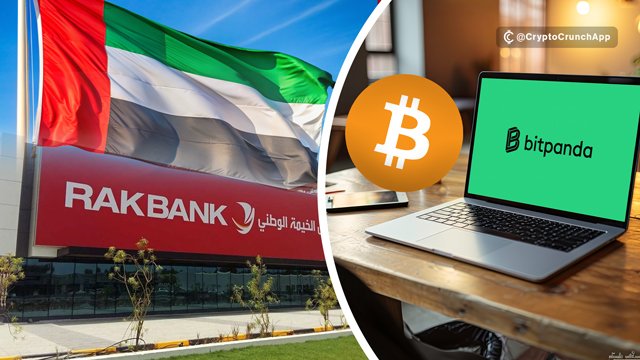
RAKBANK, a leading government-owned bank in the UAE, has teamed up with Bitpanda Technology Solutions to create a digital asset management platform for residents. Describing digital assets as the “future,” RAKBANK emphasized the importance of secure and efficient financial management through digital means. The bank aims to address a market gap by offering a regulated platform dedicated to digital assets, pending approval from the UAE’s Central Bank.
This collaboration eliminates the need for RAKBANK to develop in-house infrastructure for digital assets, leveraging Bitpanda’s expertise instead. Bitpanda’s CEO, Lukas Enzersdorfer-Konrad, expressed support for RAKBANK’s pioneering role in the UAE’s crypto space.
RAK’s commitment to digital innovation is evident, following its earlier announcement to establish a free-trade zone for digital assets. This zone, launched in October 2023 as RAK Digital Assets Oasis (RAK DAO), highlights the emirate’s focus on crypto, Web3, blockchain, and AI advancements.


Around 75% of circulating Bitcoin has remained untouched for over six months, signaling a robust holding trend among investors, according to Glassnode’s HODL Waves chart. This figure marks a significant increase from last week, where only 45% of Bitcoin had remained unmoved for the same period.
The large proportion of dormant Bitcoin suggests a decreasing supply available for trading, which could potentially push prices higher if demand continues to rise. Despite Bitcoin’s recent price dip of over 10% in the past month, the cryptocurrency has still seen a 12% surge over the last six months, hovering around $58,000.
While the holding pattern is a positive sign for long-term investors, a CryptoQuant report highlights a potential risk of miner capitulation due to squeezed profit margins. However, if demand remains strong, the reduced liquid supply could still work in favor of Bitcoin’s price recovery.

The week of August 12 to August 16, 2024, saw notable shifts in U.S. Bitcoin ETF net flows, reflecting a dynamic and evolving investor landscape. BlackRock’s IBIT stood out with a strong net inflow of 1,002 BTC, bringing its total holdings to an impressive 348,609 BTC, signaling continued investor confidence.
In contrast, Grayscale’s GBTC faced a significant outflow, losing 6,051 BTC and reducing its holdings to 230,878 BTC. This marked the most substantial decline among the ETFs tracked. Meanwhile, ARK Invest’s ARKB recorded a healthy increase, adding 385 BTC to its portfolio.
Other key movements included a 306 BTC decrease in Bitwise’s BITB and a positive addition of 390 BTC to Grayscale’s BTC fund. Fidelity’s FBTC saw a modest rise of 22 BTC, while Invesco Galaxy’s BTCO experienced a sharp drop of 848 BTC.
Across all ETFs, the total Bitcoin holdings now stand at 906,051 BTC, with a net weekly outflow of 5,292 BTC, equating to a value decrease of approximately $316.6 million. This week’s data offers a detailed snapshot of investor sentiment, highlighting a blend of optimism and caution within the Bitcoin ETF market.
Disclaimer: Market capitalizations and data can vary in real-time. The information provided here is intended purely for educational purposes and should not, under any circumstances, be construed as financial advice.
Join CryptoCrunchApp on Telegram Channels – Click to Join
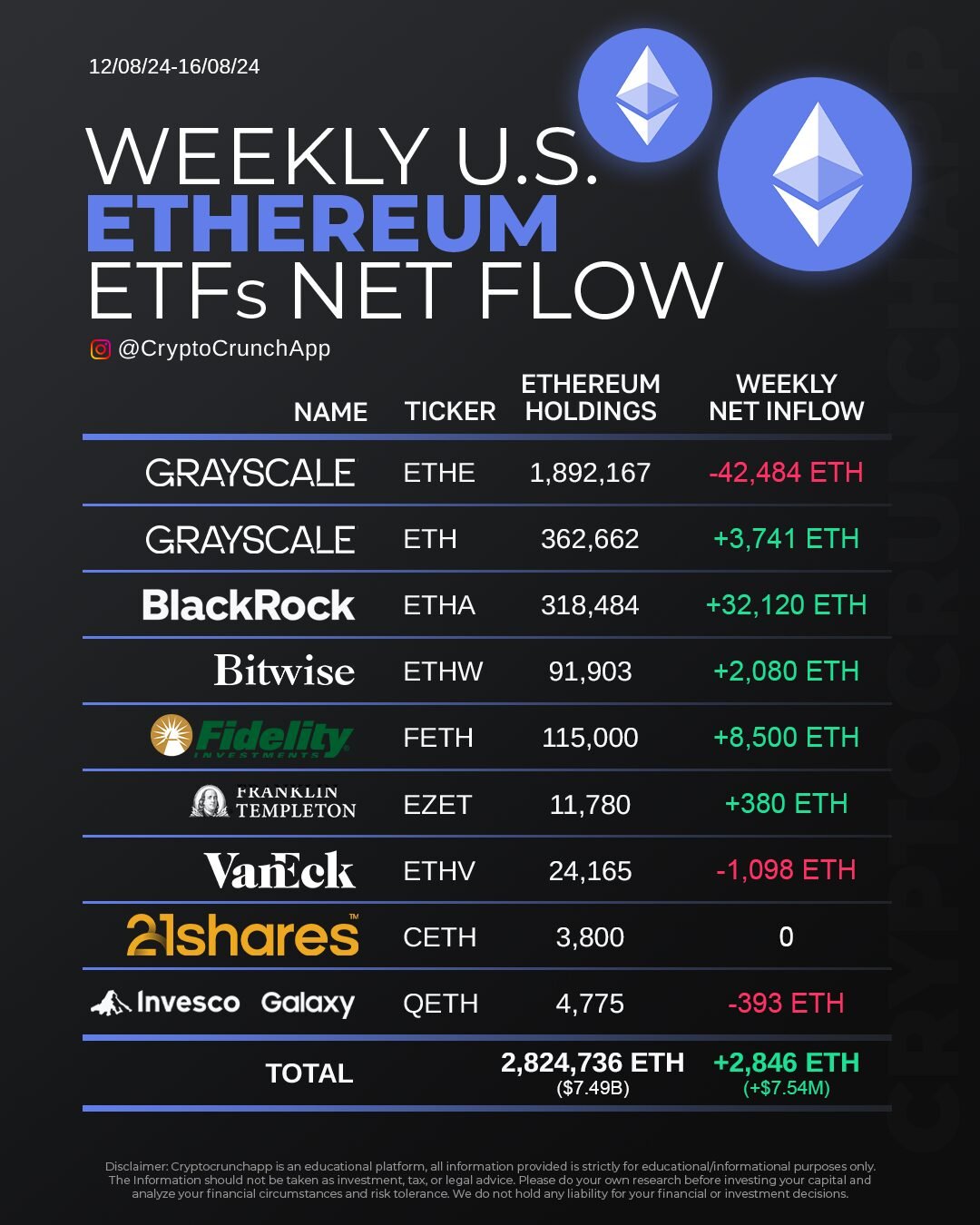
During the week spanning August 12 to August 16, 2024, U.S. Ethereum ETFs exhibited varied net flow activities, reflecting differing investor sentiments. Grayscale’s ETHE, holding a substantial 1,892,167 ETH, experienced the largest net outflow of the week at -42,484 ETH. Conversely, BlackRock’s ETHA saw a significant inflow, adding 32,120 ETH to its holdings of 318,484 ETH.
Other notable movements included Fidelity’s FETH, which gained 8,500 ETH, and Grayscale’s smaller ETH fund, which added 3,741 ETH. Bitwise’s ETHW also reported a positive net flow of 2,080 ETH.
However, not all funds experienced inflows. VanEck’s ETHV saw a reduction of 1,098 ETH, and Invesco Galaxy’s QETH had an outflow of 393 ETH. Franklin Templeton’s EZET had a modest increase, adding 380 ETH.
Overall, the total holdings for these U.S. Ethereum ETFs amounted to 2,824,736 ETH, with a net weekly inflow of 2,846 ETH, equivalent to a monetary increase of approximately $7.54 million, illustrating the dynamic nature of cryptocurrency investments within institutional frameworks.
Disclaimer: Market capitalizations and data can vary in real-time. The information provided here is intended purely for educational purposes and should not, under any circumstances, be construed as financial advice.
Join CryptoCrunchApp on Telegram Channels – Click to Join

Turkey is rapidly becoming a key player in the global cryptocurrency market as major companies like Coinbase and KuCoin race to secure business licenses in the country. Following recent regulatory updates from the Turkish Capital Markets Board (CMB), the number of applicants for these licenses has surged from 47 to 76, reflecting the growing interest in Turkey’s crypto sector.
Leading exchanges such as Binance, Bitfinex, and OKX are already in the licensing process, underscoring Turkey’s increasing importance in the crypto landscape. Although the CMB has emphasized that inclusion on the list of applicants does not guarantee approval, the wave of interest highlights the sector’s confidence in Turkey’s potential.
With Turkey ranking as the fourth-largest crypto market globally, the surge in applications signifies the country’s commitment to establishing a well-regulated and secure environment for cryptocurrency activities. This regulatory push could further solidify Turkey’s role as a central hub for digital assets.
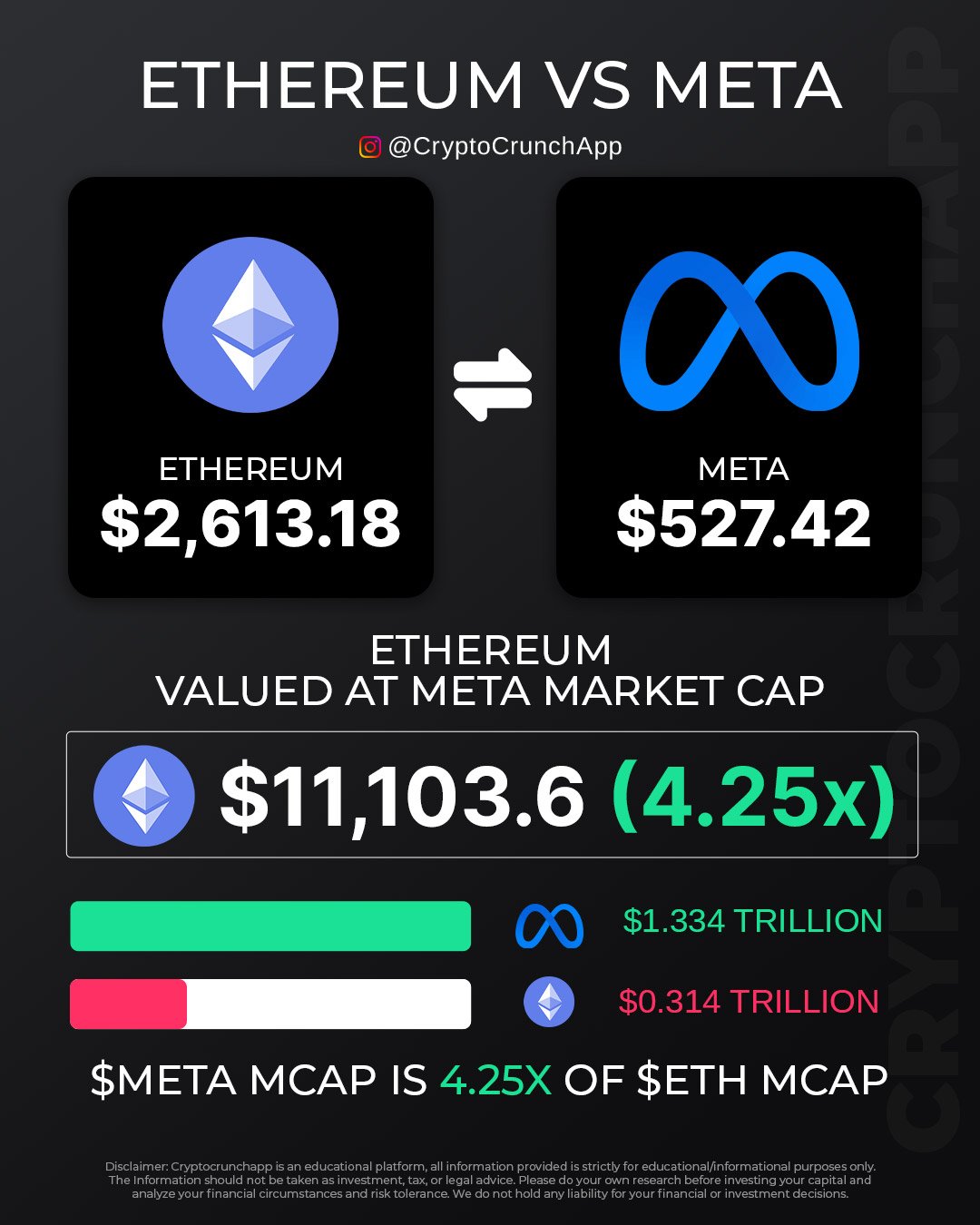
In a striking comparison, Ethereum’s market capitalization at $1.334 trillion dwarfs Meta’s market cap, which stands at $0.314 trillion. This significant difference highlights the vast financial scale at which Ethereum operates, with its market cap being 4.25 times that of Meta.
The price of Ethereum itself is $2,613.18, while Meta’s stock price is considerably higher at $527.42. However, when Ethereum’s valuation is hypothetically matched to Meta’s market cap, the price of a single Ethereum would soar to an astounding $11,103.6, over four times its current market price.
This comparison underscores the robust valuation of Ethereum in the digital economy, emphasizing its importance not just as a cryptocurrency but as a major economic entity comparable to leading global tech giants like Meta. This perspective offers a clear view of the burgeoning impact of blockchain technology and cryptocurrencies in competing with established tech industries in market valuation.
Disclaimer: Market capitalizations and data can vary in real-time. The information provided here is intended purely for educational purposes and should not, under any circumstances, be construed as financial advice.
Join CryptoCrunchApp on Telegram Channels – Click to Join

In a noteworthy development that underscores the growing acceptance of Bitcoin among traditional financial institutions, South Korea’s National Pension Service (NPS), the world’s third-largest public pension fund, has invested nearly $34 million in MicroStrategy shares.
This move, which was disclosed in a recent filing with the U.S. Securities and Exchange Commission (SEC), represents a significant step toward increasing the fund’s exposure to bitcoin, albeit indirectly.
The NPS’s investment in MicroStrategy—a business intelligence firm renowned for its massive bitcoin holdings—has attracted considerable attention. The pension fund purchased 24,500 shares in the…
Read more on bitcoinnews