Financial Transactions in the Digital Age: Beyond Traditional Cash

In today’s fast-paced world, the way we transact financially is at a crossroads of innovation and tradition. Instant gratification is no longer a luxury but a standard in transactions, with various payment methods vying for dominance by offering the quickest tap-and-go solutions. But there’s more to consider beyond just speed when selecting a payment method for both consumers and businesses.

Speed of Transactions

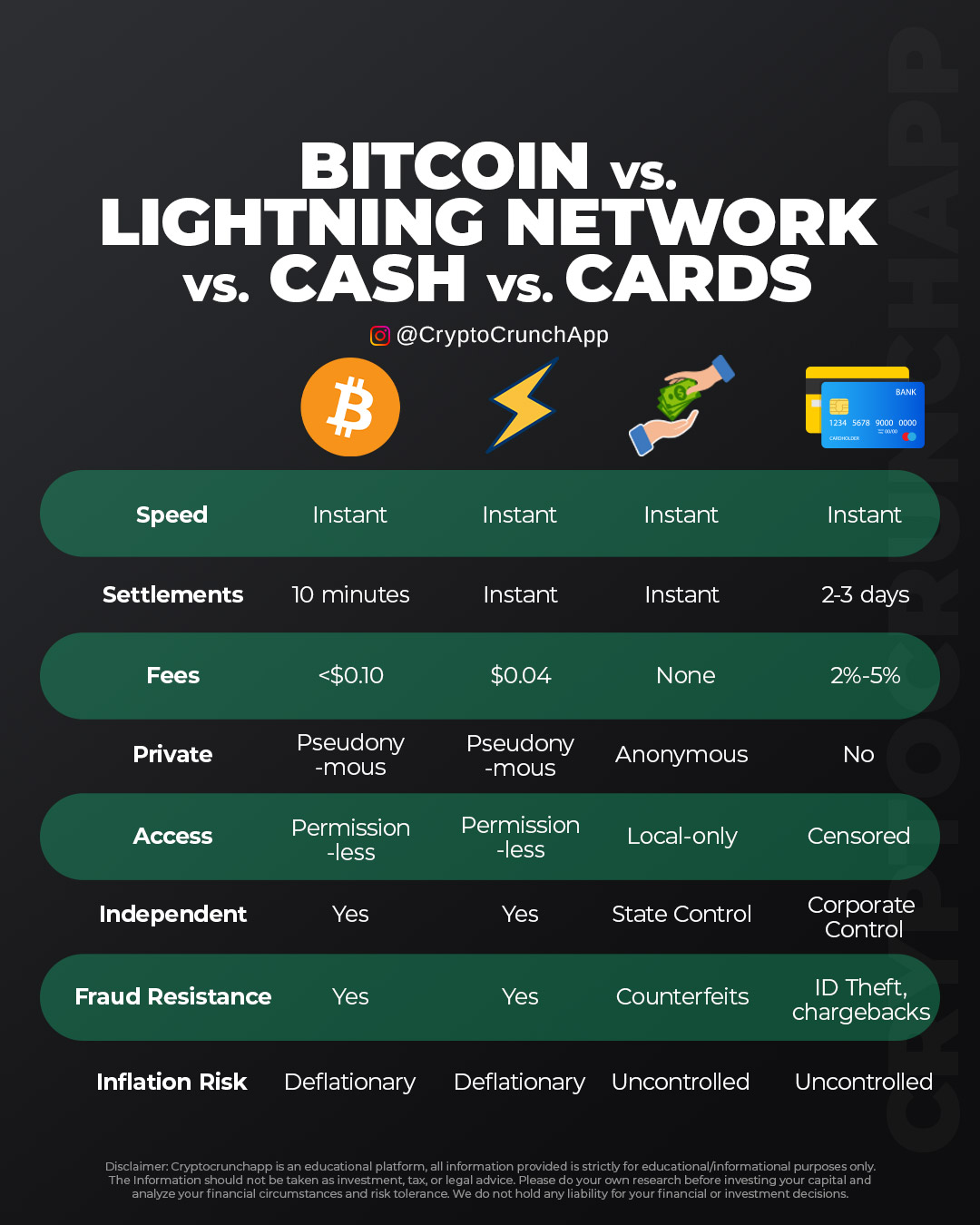
A critical factor in digital payments is the speed at which transactions are processed. Both Bitcoin and the Lightning Network boast instant transaction speeds, reflecting the rapid pace of blockchain technology. Cash transactions, being physical, are also immediate. In contrast, card payments, though electronically processed, can take a few days to settle due to the banking systems involved.

Settlement Times

The settlement time is the period it takes for a transaction to be completely processed and the funds to be available. Bitcoin typically takes about 10 minutes, as it requires multiple confirmations on the blockchain. The Lightning Network is designed for instant settlements, enhancing Bitcoin’s utility for everyday transactions. Cash is inherently instant in terms of settlement, as the exchange of physical notes finalizes the payment. Conversely, card settlements can take 2-3 days, a slower process reflective of traditional banking procedures.

Transaction Fees

Fees are a significant consideration, particularly for small businesses and regular users. Bitcoin’s transaction fees are generally low, typically less than $0.10, while the Lightning Network reduces this further to $0.04. Cash, on the other hand, does not incur transaction fees. Card payments can be costly, with fees ranging from 2-5%, impacting the overall cost of goods and services.

Privacy

In terms of privacy, Bitcoin and the Lightning Network offer pseudonymity, meaning transactions are recorded without revealing the user’s true identity directly. Cash transactions remain anonymous, with no traceability once the cash changes hands. Card payments are not private, as they require personal identification and are traceable through bank statements.

Access

Accessibility to these payment methods varies. Bitcoin and the Lightning Network are permissionless, allowing anyone with internet access to participate without the need for a centralized authority’s approval. Cash is locally accessible and doesn’t require permission, but it’s not suitable for online transactions. Card payments are censored in some regions and require authorization from financial institutions.

Control and Independence

Bitcoin and the Lightning Network are independent of state or corporate control, governed by decentralized protocols. Cash is controlled by state authorities, which can influence its value and use. Cards are under corporate control, with banks and credit card companies having significant power over transactions.

Fraud Resistance and Security

Bitcoin and the Lightning Network transactions are irreversible, providing strong resistance to fraud. Cash has risks of counterfeits, and cards are susceptible to identity theft and chargebacks, presenting security concerns for users.

Inflation Risk

Finally, the inflation risk associated with these payment methods varies. Bitcoin and the Lightning Network are deflationary by design, with a limited supply cap, potentially serving as a hedge against inflation. Cash and card transactions are tied to fiat currencies, which can be inflationary and are controlled by central banks and monetary policy.

In conclusion, the landscape of financial transactions is diverse and complex. Each payment method carries its set of advantages and drawbacks. Whether one prioritizes speed, cost, privacy, or security, the choice becomes a reflection of personal priorities and the context of the transaction. As the economy continues to evolve, so too will our methods of payment, each vying for a place in our wallets and our digital portfolios.

Ethereum scaling firm =nil; Foundation introduces security-focused zkEVM

Zero-knowledge technology firm =nil; Foundation has developed a new type-1 zero-knowledge Ethereum Virtual Machine (zkEVM) compiler to address security concerns identified in similar ZK-powered Ethereum scaling solutions.

Speaking exclusively to Cointelegraph, =nil; Foundation CEO and co-founder Misha Komarov says the technology prioritizes security and allows high-level programming code to be compiled automatically into Zero-Knowledge Succinct Non-Interactive Argument of Knowledge (zk-SNARKS) circuits.

The firm’s zkEVM is designed to be compatible with evmone, which is a C++ version of Ethereum’s base execution environment. The key takeaway is that the code of applications is…

Read more on Cointelegraph

KuCoin settles with New York AG for $22M, will depart New York

KuCoin will exit the New York market, pay $22 million to settle with the New York Attorney General’s office. 

Reuters first reported the settlement.

The crypto exchange, based in the Seychelles, was sued by the NYAG in March. Letitia James, who leads the New York office, accused the exchange of not registering before allowing users to buy and sell crypto on its platform. 

In the original lawsuit, the NYAG alleged that ether constitutes a security. The March lawsuit claimed that KuCoin’s registration should have been filed before it offered ETH, LUNA or TerraUSD.

In a post on X, KuCoin CEO Johnny Lyu confirmed the news, saying that impacted users — those based in New York —…

Read more on Blockworks

The Volatility Of Nigerian Real Estate, And Why Bitcoin Makes More Sense

I’ll start by making a statement that is probably already known to many, especially bitcoiners: money is a form of energy. We expend energy to do work. Then, an agreed-upon form of remuneration that is commensurate with the amount of work put in is earned. The energy spent on that endeavor has now been converted into another form of energy: monetary energy. This does bring to mind the first law of thermodynamics, does it not? Now, it is clear that from the most minuscule events in our individual daily lives to the larger occurrences brought about by forces for which our physical plane of existence is their playground, the world is fraught with instability and chaos at almost every…

Read more on BitcoinMagazine

‘Take some rest and GO’ — Bitcoin price copies 2020 bull run fractal

Bitcoin (BTC) should not worry traders after the biggest one-day drop of 2023 if one chart fractal plays out.

In a post on X (formerly Twitter) on Dec. 12, popular trader Alan Tardigrade revealed uncanny similarities between Bitcoin now and four years ago.

Bitcoin “repeating” post-COVID uptrend

Bitcoin may be struggling to clear key long-term resistance, but one comparison suggests that it is “business as usual” for BTC price action.

Uploading a chart fractal from late 2019 through mid-2021, Tardigrade highlighted a Bitcoin bull market blueprint, which is now making a conspicuous return.

Since late 2022 — the most recent multi-year low for BTC/USD — price recovery has followed the…

Read more on Cointelegraph

Bitcoin’s water consumption: A new environmental threat?

Bitcoin, the world’s leading cryptocurrency, has long been under scrutiny for its environmental impact due to the energy-intensive nature of its mining process. 

Since its inception in 2008, Bitcoin has never been hacked. Its tight security, provided by its proof-of-work (PoW) consensus mechanism, provides value to the cryptocurrency.

PoW, however, is energy-intensive and relies on complex cryptographic algorithms requiring vast computational power.

The global popularity of Bitcoin (BTC) has resulted in its network energy consumption sitting at 147.61 terawatt-hours per year as of Dec. 7, close to the yearly average energy consumption of countries such as Poland, Ukraine and Malaysia,…

Read more on Cointelegraph

Clearpool’s KYC-compliant marketplace lands on Optimism

Clearpool has launched its institutional credit marketplace, Clearpool Prime, on Ethereum rollup Optimism. 

Clearpool Prime aims to tap into the $1.4 trillion traditional private credit market, and bring it on-chain. 

All participants who wish to use Clearpool Prime will be mandated to participate in KYC through Securitize ID and AML checks.

According to Jakob Kronbichler the CEO and co-founder of Clearpool, all transactions on Clearpool Prime are on-chain, but only whitelisted borrowers can have visibility into counterparty names and terms. 

“This approach guarantees the transparency of the ecosystem while maintaining a high level of privacy for participants. Additionally,…

Read more on Blockworks

Crypto platform WOO X partners with market maker Wintermute for liquidity boost

Crypto exchange platform Woo X has partnered with Wintermute, a crypto market maker and liquidity provider with over $3.6 trillion in cumulative trading volume. Wintermute will act as the designated liquidity provider for the crypto exchange.

The latest partnership between the two crypto-focused platforms is part of a proactive and transparent effort to onboard top-tier liquidity providers. The London and Singapore-based liquidity provider Wintermute is one of several market makers collaborating with the crypto platform.

Other liquidity providers, such as Selini Capital and Black Code Group, also support WOO X. Selini Capital, for example, has consistently contributed 15–25% of all maker…

Read more on Cointelegraph

Chinese government plans for blockchain-based identity verification

The Chinese Ministry of Public Security plans to roll out a new blockchain-based platform called RealDID to verify the real-name identities of its citizens. 

According to a press release for an event held on Dec. 12 by the Blockchain-based Service Network (BSN), a Chinese blockchain firm, the project, planned with the Chinese government,  will have multiple use cases. These include personal real name confirmation, personal data encrypted protection and certification, private logins, business identities, personal identification certificate services and information vouchers on personal identity.

The application will allow Chinese citizens to register and log into online portals…

Read more on Cointelegraph

Jimmy Wales | Wikipedia Founder

Wikipedia founder Jimmy Wales sparked a heated debate within the Bitcoin space with his recent comments comparing traditional banks to Bitcoin. His remarks triggered swift responses from notable figures in the Bitcoin community, shedding light on contrasting perspectives regarding financial systems.

Jimmy Wales’ Provocative Comparison

Jimmy Wales expressed his opinion about Bitcoin in a recent tweet, stating:

“I forgot my bank password and lost my entire net worth. No, actually, that didn’t happen, because banks work and bitcoin doesn’t.”

This statement quickly went viral, drawing the attention of prominent figures within the Bitcoin space.

I forgot…

Read more on bitcoinnews