Elizabeth Warren | Bitcoin | Hypocrasy Or Misunderstanding?

BitcoinNews.com is not investment advice.

Opinions expressed are entirely their own and do not necessarily reflect those of BitcoinNews.com

For informational purposes only. Individuals and entities should not construe any information on this site as investment, financial, legal, tax, accounting or other advice. Information provided does not constitute a recommendation or endorsement by BitcoinNews.com to buy or sell bitcoin, cryptocurrencies or other financial instruments. Forecasts are inherently limited and cannot be relied upon. Do your own research and consult a professional advisor. The opinion of authors do not reflect those of BitcoinNews.com 

Read more on bitcoinnews

BlackRock BTC ETF Plan Encourages Banks to Invest in Bitcoin

BlackRock, the world’s largest asset management firm, has officially filed a revised Spot Bitcoin Exchange-Traded Fund (ETF) application with the United States Securities and Exchange Commission (SEC), which offers “superior resistance to market manipulation.” Interestingly, this BlackRock BTC ETF revision will allow Wall Street banks to have easier access to the firm’s funds.

As per a Forbes report, the new model was first presented to the SEC in November. It aims to allow banks like JPMorgan Chase and Goldman Sachs to participate more easily in the Bitcoin market despite the strict regulations that hold them back from holding BTC on their balance sheets.

BlackRock BTC… Read more on bitcoinnews

Basel Committee suggests introducing maturity limits for stablecoin reserve assets

The Basel Committee on Banking Supervision of the Bank for International Settlements (BIS) proposed several measures on targeted adjustment to its standard on banks’ exposure to cryptoassets. A consultative document was published on the BIS website on Dec. 14. 

The document is the result of the review work conducted during 2023, which helped the committee formulate amendments to its original prudential standards for banks’ exposure to stablecoins, published in December 2022.

Proposed changes relate primarily to the composition of the reserve assets of stablecoins, specifically for crypto assets, classified under Group 1b in the prudential standards, “subject to capital requirements…

Read more on Cointelegraph

OpenAI, Axel Springer in deal to integrate AI and journalism, tackle AI ‘hallucinations’

Axel Springer, one of the largest media companies in Europe, is collaborating with OpenAI to integrate journalism into ChatGPT artificial intelligence (AI) technologies, the German publisher said in a statement on its blog on Dec. 13.

The collaboration involves using content from Axel Springer media brands to advance the training of OpenAI’s large language models. It aims to achieve a better ChatGPT user experience with up-to-date and authoritative content across diverse topics, and increased transparency through attributing and linking full articles.

Generative AI chatbots have long grappled with factual accuracy, occasionally generating false information, commonly referred to as…

Read more on Cointelegraph

Bitcoin Buying Behaviors: A Tale of Two Incomes

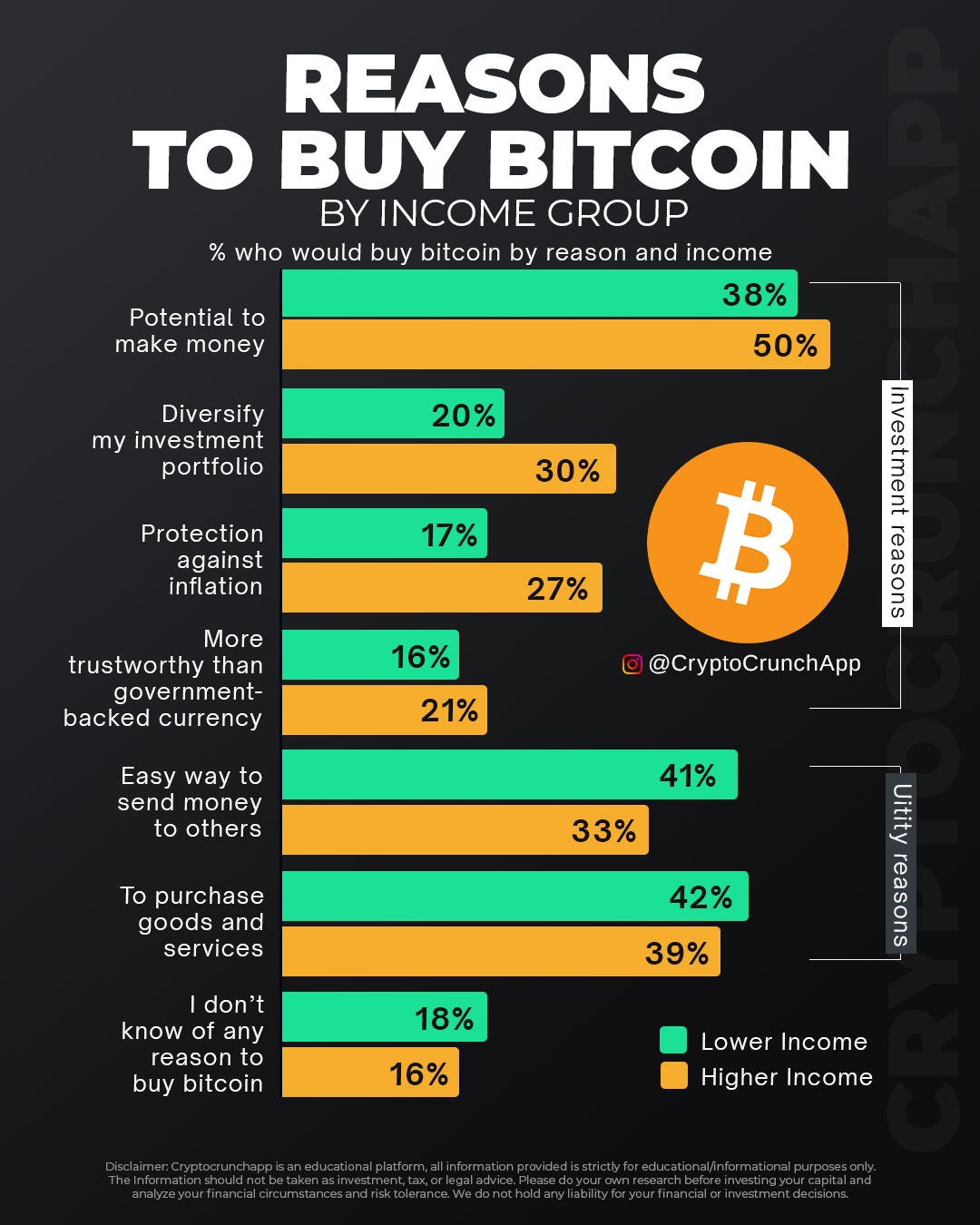
When it comes to investing in Bitcoin, it appears that motivations can vary significantly depending on one’s income level. A deeper look into the reasons why individuals from different income brackets consider purchasing Bitcoin reveals interesting patterns that highlight the diverse appeal of this cryptocurrency.

For those with higher incomes, the primary lure seems to be the potential for Bitcoin to generate profits, with 50% citing the possibility of making money as a key reason for investment. This could be indicative of a greater propensity for risk-taking and investment in speculative assets among individuals who are financially more secure.

On the other hand, the drive to diversify investment portfolios with Bitcoin is more evenly spread across income levels, though still more prevalent among the higher income group at 30% compared to 20% in the lower income bracket. This suggests that while portfolio diversification is a common investment strategy, those with higher incomes might have more capital to allocate to diverse asset classes, including cryptocurrencies.

Protection against inflation is another reason that resonates more with the higher income group. With 27% of higher earners viewing Bitcoin as a hedge against inflation, it underscores a strategic approach to preserving purchasing power in the face of currency devaluation—a concern that might be more pressing for those with significant capital to protect.

The concept of trust in currency plays an interesting role, with a notable portion of lower-income respondents, 21%, considering Bitcoin more trustworthy than government-backed currencies. This could reflect a skepticism of traditional financial institutions or a response to economic conditions where conventional currencies have failed to retain value.

Utility reasons for buying Bitcoin, such as the ease of sending money to others and purchasing goods and services, are more favored by the lower income group. This could indicate that for them, Bitcoin is not just an investment but also a functional currency that addresses certain needs or inefficiencies in the current financial systems.

Interestingly, a segment of the population remains unconvinced about Bitcoin’s merits, with 18% of the lower income group and 16% of the higher income group not recognizing any reason to buy Bitcoin. This skepticism or lack of information could represent an opportunity for educational initiatives to bridge the gap in understanding the potential benefits and risks of cryptocurrency investments.

The analysis of these investment reasons reveals a complex tapestry of financial motivations and behaviors. It highlights how socioeconomic factors can influence one’s approach to new investment vehicles like Bitcoin. With such a diverse array of incentives at play, it becomes clear that the narrative around Bitcoin is not one-size-fits-all but rather a reflection of individual financial goals and the economic landscape each investor navigates.

Philippines SEC begins Binance ban countdown

The Philippine Securities and Exchange Commission head Kelvin Lee clarified in a panel on Dec. 13 that the ban on Binance would come into effect three months after the advisory was issued.

According to a report from local news BitPinas, Lee said there has been a lot of confusion on the internet about the ban after regulators issued an advisory to the cryptocurrency exchange for operating without a license on Nov. 28.

He was asked to clarify the matter and that the ban was “supposed to be three months from the issuance date,” which he said was given on Nov. 29.

“Depending on how feedback is, we can actually extend that, but currently we should feel lucky with the three months.”

He…

Read more on Cointelegraph

Bitcoin bulls eye BTC price comeback as cash inflows echo late 2020

Bitcoin (BTC) is displaying fresh bull run signals as BTC price strength produces 7% daily gains.

BTC/USD 1-hour chart. Source: TradingViewBTC price bounces after snap sell-off

Data from Cointelegraph Markets Pro and TradingView hints that upside momentum may continue as on-chain metrics reset.

Bitcoin “needed to cool off” after hitting $44,000 this month, analysis believes, and after a trip to near $40,000, conditions are improving.

In a post on X (formerly Twitter) on Dec. 13, Philip Swift, creator of statistics resource Look Into Bitcoin, showed profit-taking surging as BTC/USD hit its latest 19-month highs.

He flagged the Value Days Destroyed (VDD) Multiple metric, which multiplies…

Read more on Cointelegraph

Crypto in the well and snake villain star in FCA’s pixelated animation

The United Kingdom’s financial regulator, the Financial Conduct Authority (FCA), has vigorously promoted its marketing rules for crypto firms since they were published in June. It’s now found a way to bring them to life, in the form of a pixelated Wild West cartoon to enlighten investors. 

A minute-long animation mimicking the style and sound of a video game appeared as an MP4 file on the FCA’s website on Dec. 13. The cartoon isn’t presented as part of a press release but is listed as a standalone, with no caption or explanation around it, on the publications page.

The cartoon explains how to judge whether crypto companies play by the FCA’s marketing rules. Crypto promo campaigns…

Read more on Cointelegraph

Opensource AI can outperform private models like Chat-GPT

While generative artificial intelligence (AI) models backed by centralized cloud infrastructure — such as ChatGPT — currently lead on overall performance, new research shows that open-source competitors are catching up.

The current market leaders of generative AI, such as Google and OpenAI, took a centralized approach to building their infrastructure — effectively limiting public access to various information, including the data sources used for the training model.

This could change, the research team at Cathy Wood’s ARK Invest claims, suggesting the possibility of open-source AI models outperforming their centralized counterparts by 2024.

MMLU performance of open-source and… Read more on Cointelegraph

Blockchain media authentication app eyes news journalism as primary use-case

Decentralized infrastructure network provider Nodle has released the first version of its blockchain-based media authentication application called Click, which could prove useful in combatting artificially generated media and fake news. 

As previously reported by Cointelegraph, Nodle has developed a software development kit (SDK) for its ContentSign solution, which cryptographically proves the integrity of data captured by mobile devices using blockchain technology.

The Click application supports the Coalition for Content Provenance and Authenticity (C2PA) and is a member of the Content Authenticity Initiative (CAI). The latter is a project led by Adobe and the Linux Foundation to create…

Read more on Cointelegraph