Transaction URL: https://blockchain.com/btc/tx/797825b910eb12242d2c84a8884b4c3e62bd8c955594f4eb723b064a7920caec
- Crunch
- Global
Ethereum has shown a diverse range of performance outcomes in the month of July over several years, characterized by significant volatility. In earlier years like 2016 and 2018, Ethereum saw modest declines of -4.5% and -4.6% respectively, indicating slight market corrections. The more substantial drops came in 2017 and 2019, with sharp declines of -30.5% and -25.3%, suggesting larger market adjustments or negative investor sentiment during those periods.
Conversely, a sharp turnaround was observed in 2020, with Ethereum surging by 53.6%. This positive momentum continued with a 12.4% increase in 2021 and an even more robust gain of 57.7% in 2022, underscoring strong bullish market conditions and increased adoption or favorable technological advancements within the Ethereum network.
However, 2023 saw a minor pullback of -3.96%, illustrating the ongoing fluctuations and the complex interplay of factors that drive the valuation of this leading cryptocurrency. Such insights into Ethereum’s July performances provide valuable indicators for investors gauging its seasonal market behaviors.
Disclaimer: Market capitalizations and data can vary in real-time. The information provided here is intended purely for educational purposes and should not, under any circumstances, be construed as financial advice.
Join CryptoCrunchApp on Telegram Channels – Click to Join
Bitcoin dipped to its lowest point since February as Mt. Gox’s trustees transferred its first repayments to crypto exchange Bitbank early Friday morning.
Mt. Gox’s transfer of 1,545 BTC ($84.87 million at the time) came after prices had already sunk more than 10% over two days, slipping from $60,330 to $53,950.
The Mt. Gox move comes as the German government continues to direct hundreds of millions of dollars in bitcoin to multiple crypto exchanges.
Germany sent bitcoin as recently as this morning, only one hour after Mt. Gox’s transfer. BTC has since recovered slightly to $55,300 and no other Mt. Gox transfers had hit the chain at time of writing.
The bigger and redder the… Read more on Blockworks
The cryptocurrency market has experienced a significant downturn.
What Happened: Bitcoin BTC/USD and other digital assets plummeted as investors shifted focus toward the impending payout to users of the defunct Mt. Gox exchange.
As of 6:00 a.m. EST, Bitcoin’s price had fallen nearly 6% in the past 24 hours to $54,500.53. This marks its first dip below the $55,000 level since Feb. 27, according to data from CoinGecko.
Meanwhile, Ethereum ETH/USD saw an even sharper decline, dropping around 9% to $2,872.10.
Overall, the entire cryptocurrency market has lost more than $170 billion in combined market capitalization within the last 24 hours.
Despite the widespread sell-off, the options market…
Read more on Benzinga
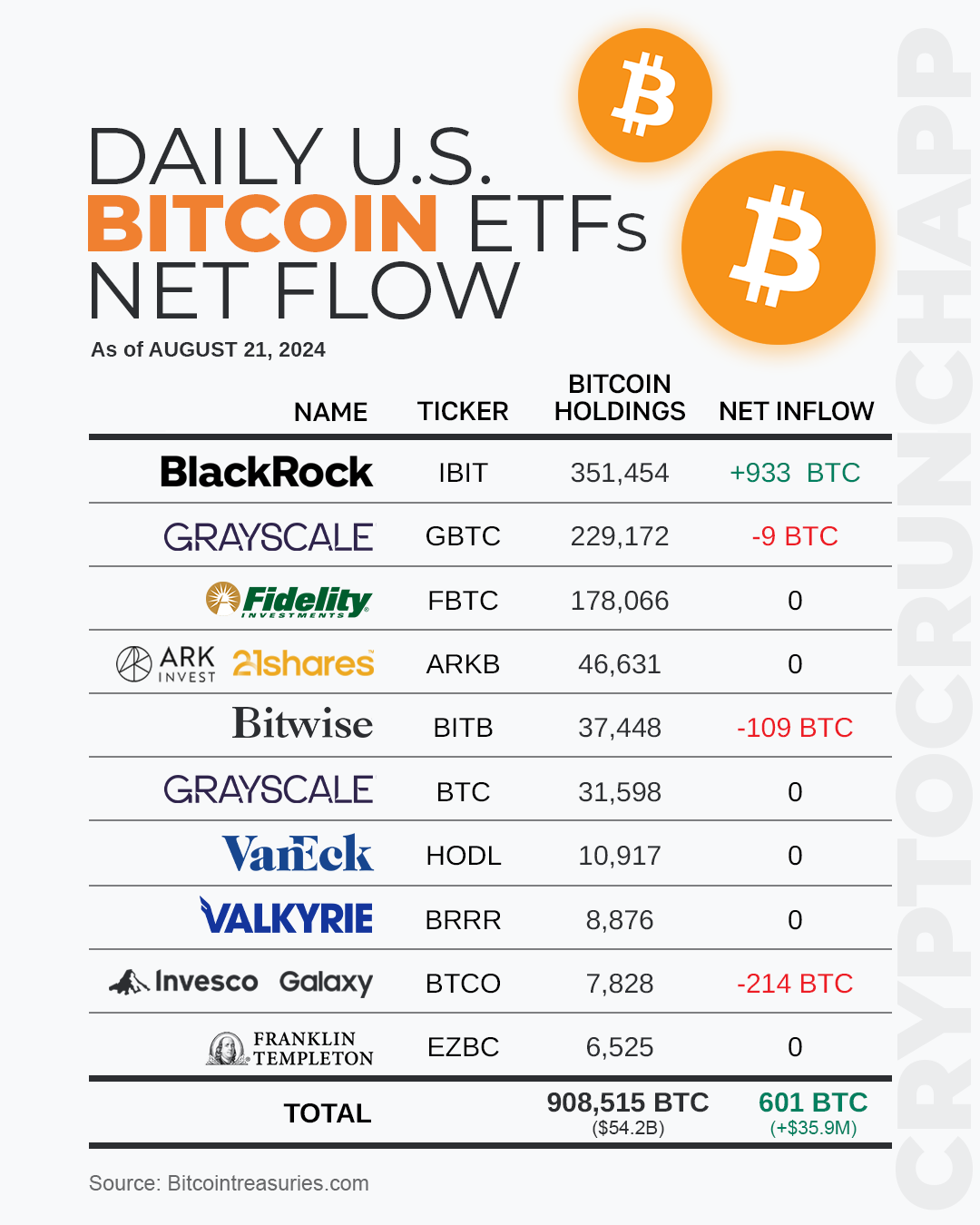
U.S. Bitcoin ETFs have shown diverse net flows, reflecting a dynamic market environment. BlackRock’s IBIT ETF leads with 307,206 BTC, maintaining stability with no net inflow or outflow. Fidelity’s FBTC ETF also held steady with 168,578 BTC, suggesting consistent investor confidence in their fund.
Grayscale’s GBTC, however, experienced a notable net outflow of 536 BTC, bringing its holdings to 274,724 BTC. This could indicate a shift in investor sentiment or strategic reallocation of assets. Conversely, ARK Invest’s ARKB and VanEck’s HODL ETFs saw positive inflows of 40 BTC and 56 BTC respectively, reflecting growing investor interest in these funds.
In total, these ETFs collectively hold 866,481 BTC, valued at approximately $47.5 billion. Despite a combined net outflow of 440 BTC, the varied performance across different ETFs underscores the evolving nature of Bitcoin investments and the differing strategies employed by investors in this burgeoning market.
Disclaimer: Market capitalizations and data can vary in real-time. The information provided here is intended purely for educational purposes and should not, under any circumstances, be construed as financial advice.
Join CryptoCrunchApp on Telegram Channels – Click to Join
Recent data from IntoTheBlock reveals that more than 30% of all Bitcoin has not been moved in over five years, indicating a robust belief in the cryptocurrency among long-term holders. This substantial portion of the Bitcoin supply, tracked through Unspent Transaction Outputs (UTXOs), shows these funds have remained untouched despite significant price fluctuations, suggesting that many view Bitcoin as a viable store of value.
The persistence of these long-term holders helps stabilize Bitcoin’s market, establishing a steady base of demand and valuation. While some of these coins may be lost, the majority are held by investors who are less concerned with short-term market movements and more focused on long-term potential.