Transaction URL: https://etherscan.io/tx/0x2f312fa0067f8ecab94de1c4faef584bd423d69f03d277280837b62ab2d5e2df

- Crunch
- Global

Crypto.com, a leading figure in the crypto industry, proudly announces a new feature for U.S. customers, allowing them to use PayPal to fund cryptocurrency purchases. This integration facilitates seamless transfers between PayPal and Crypto.com accounts, enabling users to buy a variety of crypto tokens easily. The service is set to expand to other markets soon, signaling a significant advance in cryptocurrency accessibility.
Eric Anziani, President and COO of Crypto.com, emphasized the importance of blending traditional and digital payment methods to promote the widespread adoption of cryptocurrencies. He remarked, “We are tremendously proud to partner with PayPal, a titan in digital commerce, to enhance the safe and efficient use of digital currencies globally.”
This development is part of a broader collaboration between Crypto.com and PayPal, which includes previous initiatives such as enabling PayPal for topping up the Crypto.com Visa Card and integrating PayPal USD (PYUSD) on Crypto.com’s payment platform. Jose Fernandez da Ponte of PayPal highlighted the commitment to offering users more flexibility in funding their crypto transactions, enhancing the overall user experience.

This article is featured in Bitcoin Magazine’s “The Halving Issue”. Click here to get your copy. It is also report #1 of the “FUD Fighters” series powered by HIVE Digital Technologies LTD.
F%$K Bad Research: I spent over a month analyzing a bitcoin mining study and all I got was this trauma response.
“We must confess that our adversaries have a marked advantage over us in the discussion. In very few words they can announce a half-truth; and in order to demonstrate that it is incomplete, we are obliged to have recourse to long and dry dissertations.” — Frédéric Bastiat, Economic Sophisms, First Series (1845)
“The amount of energy needed to refute bullshit is an order of…
Read more on BitcoinMagazine
Telegram CEO Pavel Durov was indicted on Wednesday, per Bloomberg.
The report says that a French court indicted the executive on charges including organizing or enabling illicit transactions.
A previous press release from Aug. 26 lists the charges Durov is facing, including complicity in offering and selling narcotic substances and distributing child pornography. Durov, as the CEO of Telegram, faces the accusations.
French authorities also allege that Durov didn’t aid investigations.
The earlier press release also says that Durov has already faced interrogations from the French investigators.
Durov, who was arrested in France last week, was placed under judicial supervision. He…
Read more on Blockworks

Telegram CEO Pavel Durov was indicted on Wednesday, per Bloomberg.
The report says that a French court indicted the executive on charges including organizing or enabling illicit transactions.
A previous press release from Aug. 26 lists the charges Durov is facing, including complicity in offering and selling narcotic substances and distributing child pornography. Durov, as the CEO of Telegram, faces the accusations.
French authorities also allege that Durov didn’t aid investigations.
The earlier press release also says that Durov has already faced interrogations from the French investigators.
Durov, who was arrested in France last week, was placed under judicial supervision. He…
Read more on Blockworks

This article is featured in Bitcoin Magazine’s “The Halving Issue”. Click here to get your copy.
If, in 2021, the identity of Satoshi Nakamoto remains a mystery, so too does the two-year period from 2008 to 2010 when Bitcoin’s creator served as the project’s principal developer and leader.
Yet, far from a lifeless period of project development, during those years Nakamoto worked with dozens if not hundreds of Bitcoin users, all of whom contributed to the effort in different ways, establishing websites, engaging in commerce and evangelizing for his invention.
Still, some users naturally emerged as more distinguished contributors.
Whether it was by helping establish core elements…
Read more on BitcoinMagazine
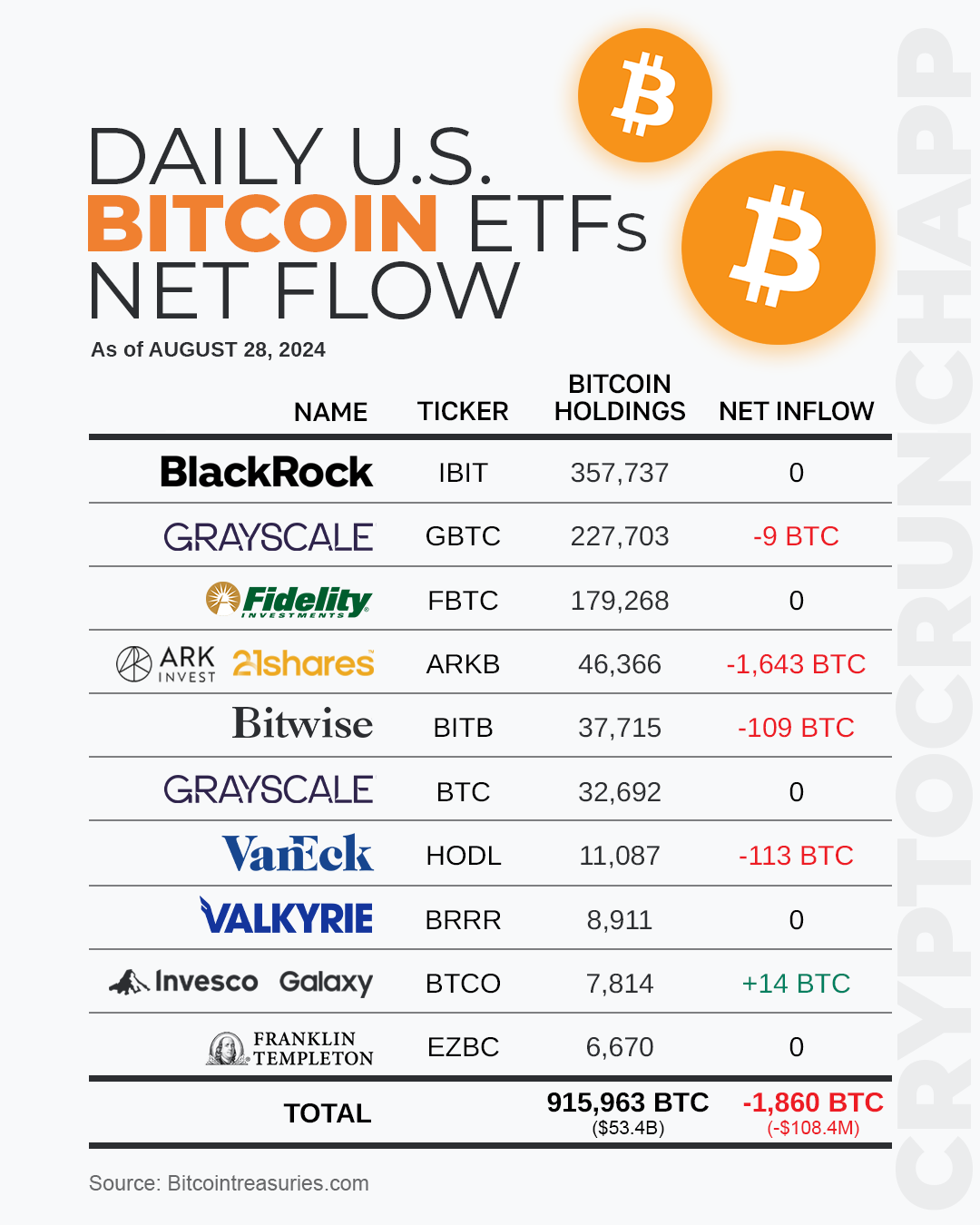
On August 28, 2024, the U.S. Bitcoin ETF market witnessed varying degrees of net inflow and outflow among key players. BlackRock’s IBIT and Fidelity’s FBTC showed stability with zero net change in Bitcoin holdings, maintaining their positions with 357,737 and 179,268 BTC respectively.
However, notable outflows were observed in other ETFs: ARK Invest’s ARKB saw a reduction of 1,643 BTC, Bitwise’s BITB experienced a decrease of 109 BTC, and VanEck’s HODL faced a drop of 113 BTC. Conversely, Invesco Galaxy’s BTCO registered a positive net inflow, adding 14 BTC.
Grayscale’s GBTC ETF also faced a slight outflow, decreasing by 9 BTC, highlighting a minor shift in investor sentiment. Despite these fluctuations, the total Bitcoin held by these ETFs combined reached 915,963 BTC, with a net outflow of 1,860 BTC, equivalent to a decrease of approximately $108.4 million in asset value.
This snapshot offers valuable insight into the daily dynamics and investor behavior within the U.S. Bitcoin ETF market, reflecting the ongoing adjustments in investment strategies in response to broader market conditions.
Disclaimer: Market capitalizations and data can vary in real-time. The information provided here is intended purely for educational purposes and should not, under any circumstances, be construed as financial advice.
Join CryptoCrunchApp on Telegram Channels – Click to Join
Spot ether ETFs — available on the US market for just over a month now — notched their ninth straight day of net outflows Tuesday.
The category’s net flows remain in the red at $482 million since their late July launch, according to Farside Investors data.
Read more: One month in the books for US spot ETH ETFs
Bitcoin ETFs saw collective positive flows for eight straight days during that span, though the streak came to an end on Tuesday.
The BTC funds’ $252 million of net inflows on Aug. 23 (the most in a single day since July 22) came the same day Federal Reserve Chair Jerome Powell hinted at a rate-cutting cycle. Contrarily, about $13 million left ether ETFs that…
Read more on Blockworks
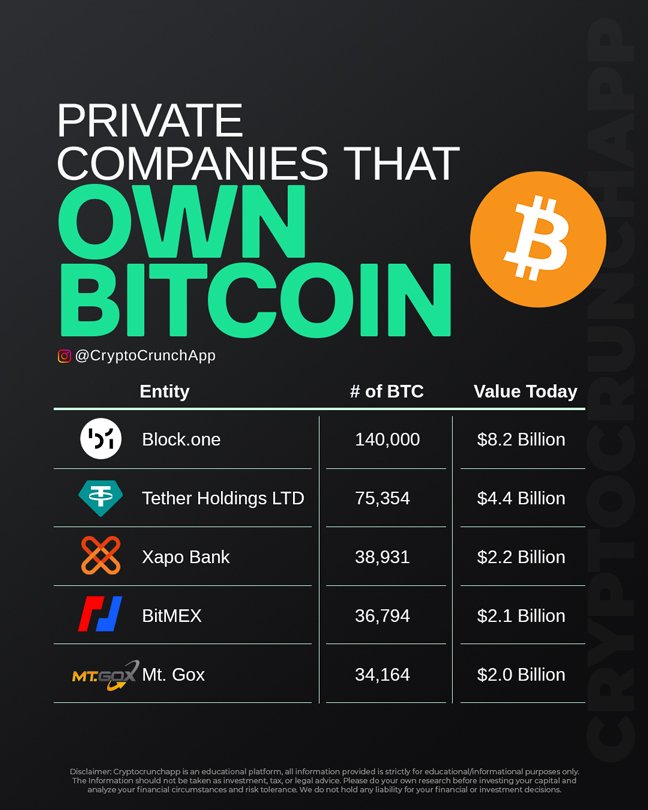
A number of private companies have made substantial investments in Bitcoin, showcasing their belief in the cryptocurrency’s value as an asset class. Leading the charge, Block dot one holds an impressive 140,000 BTC, valued at approximately $8.2 billion. This significant investment underscores the company’s commitment to Bitcoin’s future potential.
Following closely, Tether Holdings LTD has accumulated 75,354 BTC, worth around $4.4 billion. Their investment highlights the growing trend of fintech companies diversifying into cryptocurrency.
Xapo Bank and BitMEX are also notable players, holding 38,931 BTC and 36,794 BTC respectively, with their Bitcoin assets valued at $2.2 billion and $2.1 billion. These holdings demonstrate the increasing acceptance of Bitcoin as a legitimate reserve asset among private financial institutions.
Lastly, the infamous Mt. Gox, despite its turbulent history, still holds 34,164 BTC, valued at $2.0 billion. This reflects the enduring value of Bitcoin even amidst past controversies.
These investments by private companies not only illustrate the widespread corporate belief in Bitcoin as an investable asset but also highlight its role in business strategies as a store of value and a hedge against traditional financial systems.
Disclaimer: Market capitalizations and data can vary in real-time. The information provided here is intended purely for educational purposes and should not, under any circumstances, be construed as financial advice.
Join CryptoCrunchApp on Telegram Channels – Click to Join