Transaction URL: https://etherscan.io/tx/0x9c9bf876ca4de0d934cd03dde5f924cb74eedea7b41aba1f1c1e4717dca78a65

- Crunch
- Global

Telegram, the messaging app cherished by cryptocurrency enthusiasts, reported holding $400 million in digital assets at the end of 2023. With revenues deeply entrenched in crypto-related activities, about 40% of its annual income stems from its “integrated wallet” and “sale of collectibles,” combining to nearly $148 million. This integrated wallet facilitates storage, trading, and transactions of crypto assets directly within the app.
Amid these developments, Pavel Durov, Telegram’s founder, faces legal challenges in France, with accusations centered on the app’s alleged facilitation of illicit activities. Despite this, the Financial Times highlights Telegram’s robust financial health and a valuation upwards of $30 billion, underpinned by Durov’s complete ownership and significant external investments from major global funds.
As the platform approaches a billion users, its engagement with the crypto world deepens, evidenced by recent spikes in popularity for crypto games like Notcoin and Hamster Kombat. These games, leveraging the TON blockchain, underscore Telegram’s pivotal role in the expanding universe of digital collectibles and cryptocurrency transactions.

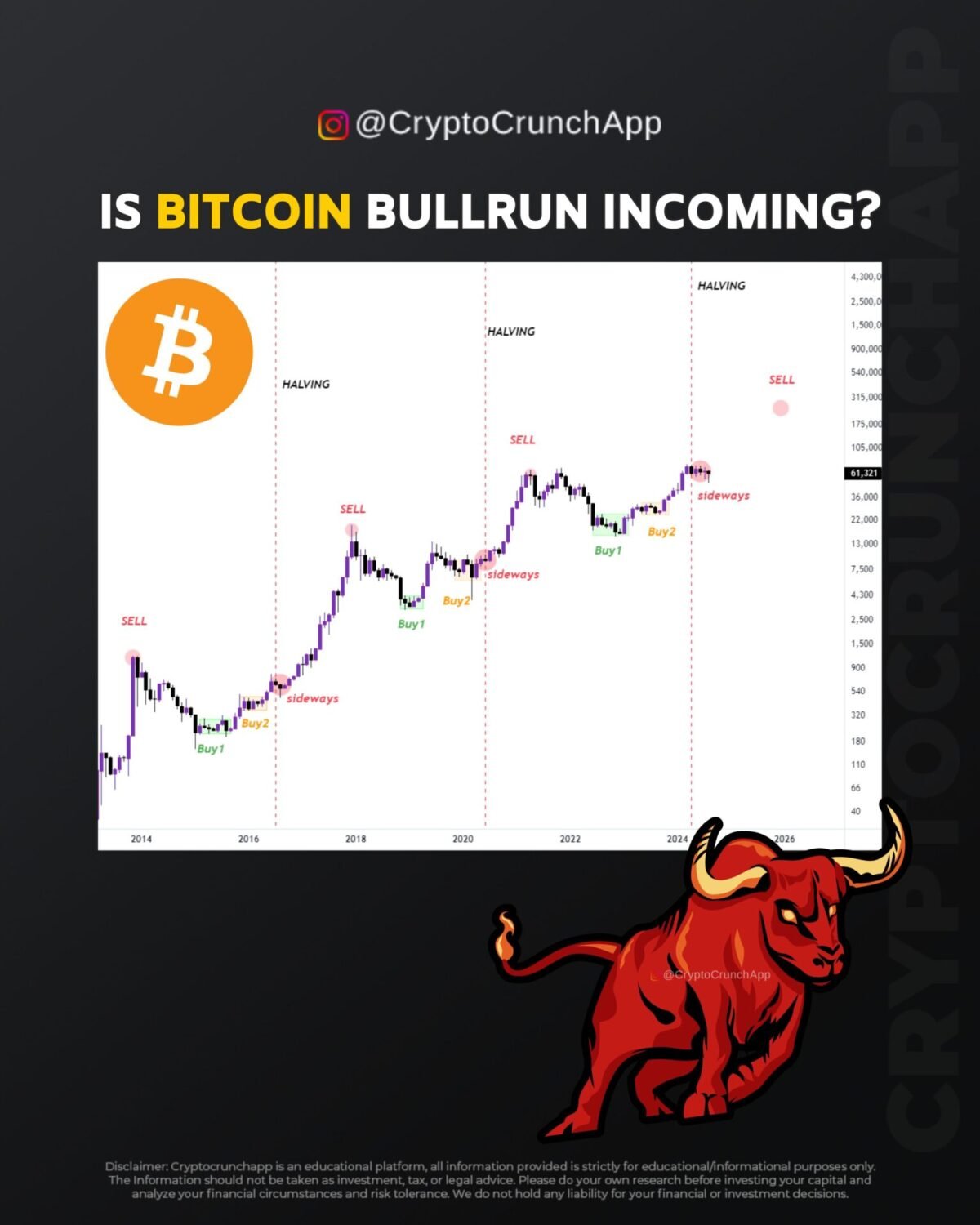
When it comes to Bitcoin, there’s often a gap between expectation and reality. Many people imagine Bitcoin’s price trajectory as a steady, upward climb, reflective of widespread media portrayals and optimistic forecasts. This visual representation is straightforward and suggests a linear progression.
In reality, Bitcoin’s price movement is far from linear. It involves periods of significant volatility, characterized by sharp rises and sudden declines. The true path is one of accumulation, where the price sometimes dips, offering opportunities for investors to buy in before it escalates again. This cyclical nature can be challenging to navigate but is a fundamental aspect of Bitcoin’s market behavior.
Understanding the real dynamics behind Bitcoin’s value fluctuations is crucial for investors. It prepares them for the inherent risks and potential rewards that come with entering the cryptocurrency market.
Disclaimer: Market capitalizations and data can vary in real-time. The information provided here is intended purely for educational purposes and should not, under any circumstances, be construed as financial advice.
Join CryptoCrunchApp on Telegram Channels – Click to Join
Overview
Vitalik Buterin, co-founder of Ethereum, is one of the most influential figures in the cryptocurrency industry. As a prominent developer and thought leader, Buterin’s contributions to Ethereum, the second-largest cryptocurrency by market capitalization, have positioned him as a key player in the digital asset space.
Ethereum Holdings
Recent data provides significant insights into Vitalik Buterin’s Ethereum (ETH) holdings:
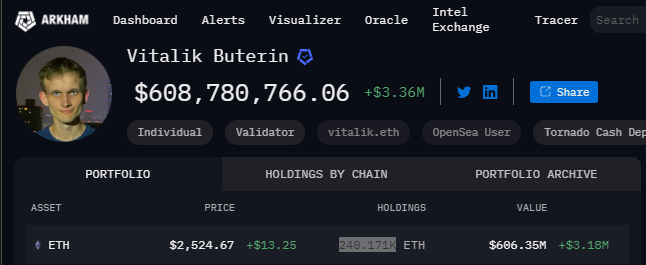
- Current Holdings: Vitalik Buterin currently holds 240,171 ETH.
- Estimated Value: This holding is valued at approximately $606 million.
- Historical Holdings: Three years ago, Buterin publicly disclosed that he held 325,000 ETH, valued at $1.46 billion at the time, when ETH was priced at $4,500 per coin.
Net Worth and Wealth Distribution
Vitalik Buterin has publicly stated that nearly 90% of his net worth is concentrated in Ethereum. This belief underscores his confidence in ETH as a store of value (SOV). Buterin himself noted, “If I did not believe in ETH as SOV, I would not hold nearly 90% of my net worth in it.”
Conclusion
Vitalik Buterin’s Ethereum holdings highlight his strong commitment to the platform and his belief in its long-term value. Despite fluctuations in the price of ETH and the reduction in his holdings over the past few years, Buterin remains one of the top individual holders of Ethereum, with his holdings currently valued at over $600 million.

This article is featured in Bitcoin Magazine’s “The Privacy Issue”. Subscribe to receive your copy.
First they ignore you, then they laugh at you, then they fight you, then you win.The quote—commonly misattributed to Mahatma Gandhi—has been overused to the point of exhaustion in the Bitcoin space, typically invoking the suggestion that the laughing stage is over. In most of these cases, the insinuation that the fighting stage has begun was overblown, however; perhaps inspired by little more than a comment from some politician or finance professional.But on April 24 of this year, the quote finally rang true.
On that day, the US Department of Justice (DoJ), via the District Court of the…
Read more on BitcoinMagazine
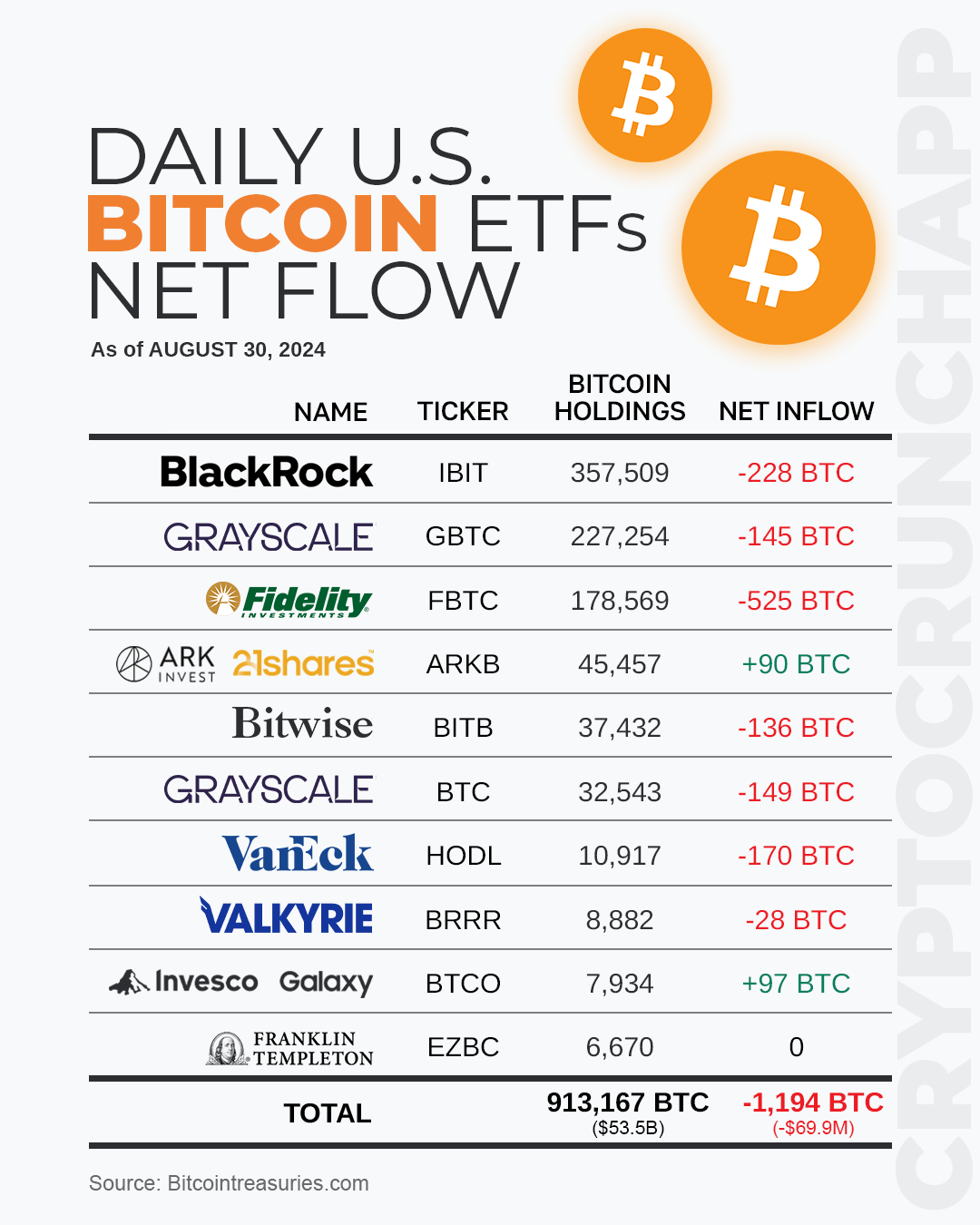
The daily net flows of Bitcoin ETFs in the U.S. on August 30, 2024, reveal a mixed landscape of investments and withdrawals across various funds. Notably, BlackRock’s IBIT experienced a net outflow of 228 BTC, indicating a slight decrease in holdings, which still total an impressive 357,509 BTC.
Grayscale’s GBTC and Fidelity’s FBTC also saw net outflows of 145 BTC and 525 BTC, respectively, suggesting a day of more withdrawals than purchases. Conversely, ARK Invest’s ARKB and Invesco Galaxy’s BTCO saw net inflows, gaining 90 BTC and 97 BTC, respectively, hinting at growing investor confidence in these ETFs.
Other ETFs like Bitwise’s BITB and VanEck’s HODL recorded net outflows of 136 BTC and 170 BTC. Valkyrie’s BRRR had a minimal outflow of 28 BTC.
The overall movement in the market for the day totaled a net outflow of 1,194 BTC, equivalent to a decrease in value of approximately $69.9 million, based on the day’s Bitcoin price. This snapshot offers a crucial perspective on the shifting dynamics within the Bitcoin investment space, reflecting how institutional and individual actions shape the market on a daily basis.
Disclaimer: Market capitalizations and data can vary in real-time. The information provided here is intended purely for educational purposes and should not, under any circumstances, be construed as financial advice.
Join CryptoCrunchApp on Telegram Channels – Click to Join
For years, Bitcoin enthusiasts have been expecting a significant change in the value due to the involvement of institutional investors. The concept was simple: as companies and large financial entities invest in Bitcoin, the market would experience explosive growth and a sustained period of rising prices. However, the actual outcome has been more complex. Although institutions have indeed invested substantial capital in Bitcoin, the anticipated ‘supercycle’ has not unfolded as predicted.
Institutional Accumulation
Institutional participation in Bitcoin has significantly increased in recent years, marked by substantial purchases from large companies and the introduction of Bitcoin…
Read more on BitcoinMagazine

Binance has confirmed its readiness to facilitate the Cardano (ADA) network upgrade and the anticipated Chang hard fork on September 1. This development follows a delay from the initially scheduled August 27, as the crypto exchange needed more time to prepare. Binance has planned a temporary suspension of ADA token deposits and withdrawals during the hard fork to ensure a smooth transition and to mitigate any potential technical issues.
In a proactive move, Binance will manage all technical requirements for the upgrade, promising a seamless experience for its users. The trading platform aims to ensure ADA’s compatibility with the new network changes, with plans to resume all token activities once the network stabilizes post-upgrade. This strategy highlights Binance’s commitment to providing a superior user experience and maintaining trust within the crypto community.
The Chang hard fork is a significant step in Cardano’s evolution, marking the beginning of the “Age of Voltaire.” This upgrade aims to introduce decentralized governance through Delegate Representatives (DReps), further empowering ADA token holders and enhancing the network’s democratic framework. This strategic upgrade is expected to bolster the blockchain’s functionality and its appeal to institutional and individual participants alike.