Is ‘pervasive quiet quitting’ crypto’s latest trend?

Today, enjoy the Empire newsletter on Blockworks.co. Tomorrow, get the news delivered directly to your inbox. Subscribe to the Empire newsletter.

Vibe check 

The vibes are…weird.

Both bitcoin and ETH are down over 4% this morning according to Coinbase. Bitcoin’s clinging to $56,000 while ETH holds on to $2,300. 

If you asked Ikigai’s Travis Kling, he’d say that there’s a new attitude taking over in crypto: “Pervasive quiet quitting.”

Yes, the quiet quitting concept that went viral a few years ago, where folks just stop doing more than what was expected of them. It was labeled as giving up — though I think we can agree that perhaps it’s a situational thing, and you…

Read more on Blockworks
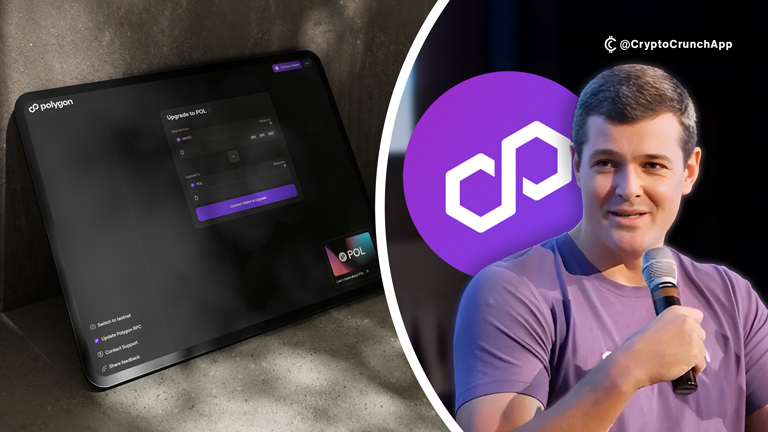
LATEST: Polygon Announces Official Transition of MATIC Token to POL

Polygon developers have announced the exciting transition of the MATIC token to the new POL token on their Proof of Stake (PoS) chain. This change introduces POL as the native gas and staking token, maintaining the original 10 billion token supply and MATIC’s established tokenomics. The upgrade, a key part of Polygon’s evolution into a Zero-Knowledge (ZK) chain and integration with AggLayer, is designed to enhance liquidity and interoperability across multiple chains.

The switch to POL marks a significant milestone, with the initial exchange rate set at 1:1. A gradual increase in emissions over ten years aims to foster network growth and incentivize participation by new validators. As the upgrade progresses, MATIC holders on the Polygon PoS chain will automatically transition to POL, whereas those on other platforms will need to migrate their tokens manually.

With the upgrade, POL will play a crucial role in block production, zero-knowledge proof generation, and participation in Data Availability Committees, advancing Polygon’s capabilities in the cryptocurrency ecosystem. This strategic move positions Polygon as a leader in blockchain scalability and efficiency.

LATEST: Cantor Fitzgerald’s CEO Says TradFi’s Shift Towards Bitcoin Usage

Howard Lutnick, CEO of Cantor Fitzgerald, recently highlighted the potential for Bitcoin to integrate into traditional finance (TradFi). In a statement on X, Lutnick expressed that many TradFi companies are eager to engage with Bitcoin as a new asset class but are constrained by stringent U.S. regulatory frameworks. He emphasized Bitcoin’s outsider status within the TradFi community, noting its gradual entry into global finance.

Lutnick explained the current regulatory challenges, stating, “If a bank were to hold your Bitcoin, they would need to set aside an equivalent amount of their own funds, effectively locking that capital.” He believes that with a more supportive regulatory environment, traditional financial institutions would dive headfirst into Bitcoin. The CEO, who also heads a new Bitcoin financing initiative by Cantor Fitzgerald, foresees significant shifts if regulations are adjusted, aligning with the growing crypto-positive sentiment among financial leaders.

https://twitter.com/CryptoCrunchApp/status/1831263086835388591

FBI Warns of North Korean Hackers Targeting U.S. Bitcoin And Crypto ETFs

Today, the FBI issued an alert warning that North Korean hackers are targeting U.S. cryptocurrency exchange-traded funds (ETFs) in a bid to steal digital assets. The hackers are using advanced social engineering techniques to breach the security of companies associated with these financial products, the FBI stated.

According to the FBI, the Democratic People’s Republic of Korea (DPRK) has been conducting highly targeted social engineering attacks on employees within the decentralized finance (DeFi) and cryptocurrency industries. These attacks involve detailed…

Read more on BitcoinMagazine

Privacy and Pain: Craig Raw, Creator Of Sparrow Wallet, On Self-Custody

This article is featured in Bitcoin Magazine’s “The Privacy Issue”. Subscribe to receive your copy.

When Craig Raw talks, you listen.

His deep voice has a gravity to it, bolstering the urgency of the points he makes.

It’s like that voice in the back of your head that you hear when you’ve left too much bitcoin on an exchange for too long. Or that voice that persists when your bitcoin stash isn’t quite as secure as you know it could be.

It’s an uncompromised voice, constantly reminding you to follow best practices when it comes to storing and using your bitcoin.

Weeks after interviewing Raw — creator of let Sparrow Wallet, a free and open-source Bitcoin desktop wallet beloved by…

Read more on BitcoinMagazine

ISM PMI’s hint at further goods disinflation

Today, enjoy the On the Margin newsletter on Blockworks.co. Tomorrow, get the news delivered directly to your inbox. Subscribe to the On the Margin newsletter.

Welcome to the On the Margin Newsletter, brought to you by Ben Strack, Casey Wagner and Felix Jauvin. Here’s what you’ll find in today’s edition:

A look at the weird things related to today’s ISM manufacturing PMI.
The bull and bear BTC price cases heading into autumn, given expected rate cuts.
Why the SEC might object to FTX’s repayment plans.  

Markets are being rocked by some weird things from the ISM manufacturing PMI that came out today. Following a weak monthly print of 46.8 in July, a rebound was…

Read more on Blockworks

Isolation is no longer an option for L1 blockchains

Layer-1 networks can no longer afford to operate in isolation. To remain relevant and competitive, these networks must prioritize multichain technology and interoperability. The future of Web3 is interconnected, and any layer-1 that fails to evolve risks obsolescence.

The blockchain ecosystem has undergone a profound transformation over the past few years. The introduction of Ethereum’s 2022 merge and the ongoing development of shard chains have set new benchmarks for what layer-1 blockchains can achieve. These innovations have compelled layer-1s to enhance their functionalities to meet the growing demands of the ecosystem.

This competitive pressure is further intensified by the…

Read more on Blockworks

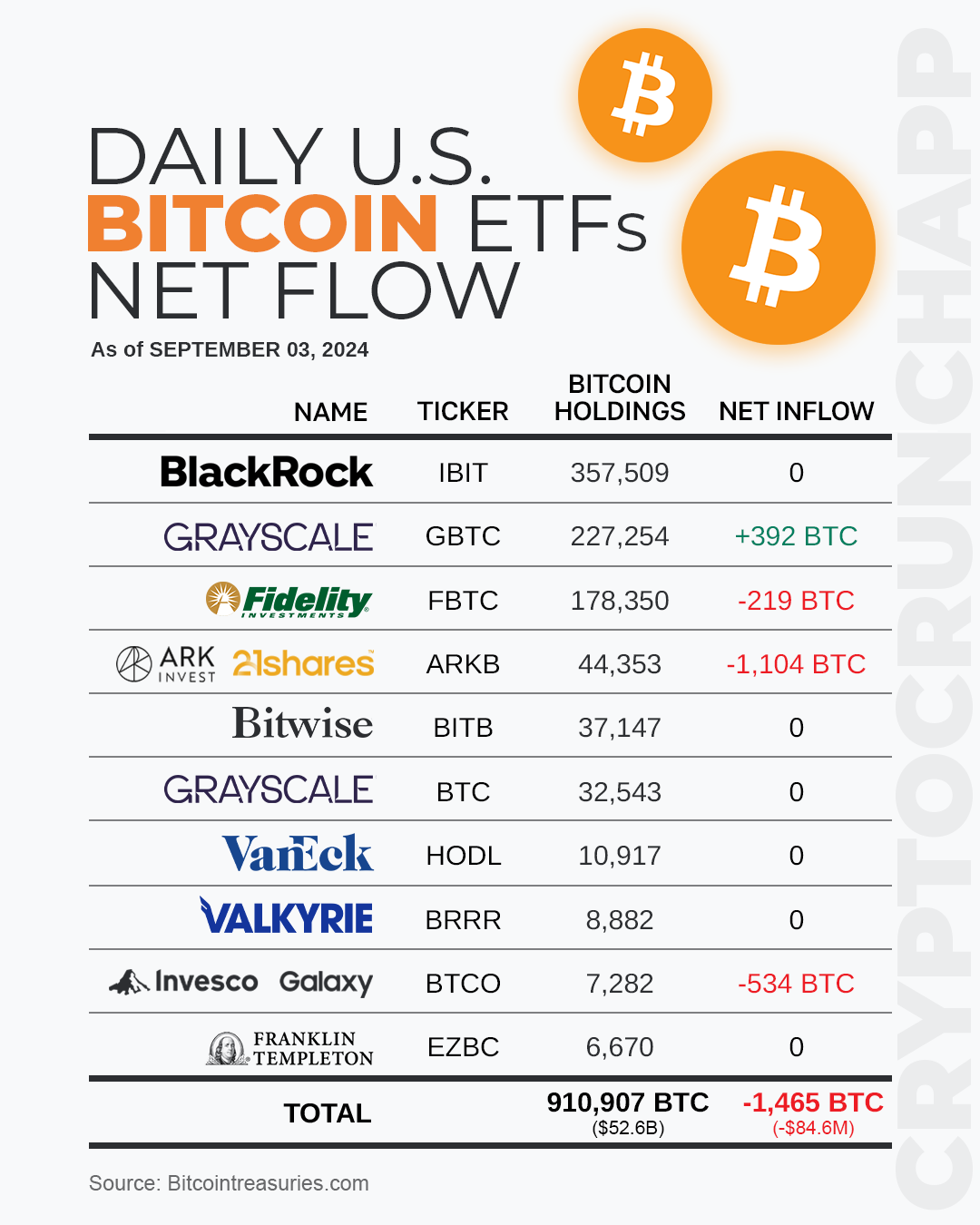
Daily US Bitcoin ETFs Net Flow Analysis (As of September 03, 2024)

As of September 3, 2024, the daily net flow of Bitcoin ETFs in the U.S. presents some notable changes. Grayscale’s GBTC ETF saw a significant positive net inflow of 392 BTC, reflecting increasing investor confidence and bringing its total holdings to 227,254 BTC. Conversely, ARK Invest’s ARKB experienced a substantial outflow of 1,104 BTC, and Invesco Galaxy’s BTCO also faced a decrease, shedding 534 BTC.

Fidelity’s FBTC ETF noted a decrease of 219 BTC, indicating a shift in investor sentiment or rebalancing of portfolios. Despite these outflows, some funds like BlackRock’s IBIT and Bitwise’s BITB maintained stability with no net inflows or outflows, indicating a steady state during the trading session.

Overall, the total holdings across these ETFs amounted to 910,907 BTC, with a net outflow of 1,465 BTC, translating into a monetary decrease of approximately $84.6 million. This daily snapshot offers investors a clear view of the inflows and outflows within major Bitcoin ETFs, highlighting the dynamic nature of cryptocurrency investments in the current economic climate.

Disclaimer: Market capitalizations and data can vary in real-time. The information provided here is intended purely for educational purposes and should not, under any circumstances, be construed as financial advice.

Join CryptoCrunchApp on Telegram Channels – Click to Join

A Decade of Bitcoin Prices on September 3rd

The evolution of Bitcoin prices on September 3rd over the past years offers a fascinating glimpse into the volatile yet upward trajectory of this premier cryptocurrency. Starting at a modest $9 in 2011, the figures began to rise steadily, reaching $10 in 2012. This initial growth set the stage for a dramatic increase in subsequent years.

By 2013, the amount soared to $130, and by 2014, it surged to $476. Despite a dip to $229 in 2015, the upward trend resumed, with a substantial jump to $581 in 2016. This period of growth laid the foundation for an impressive leap to $4.5K in 2017.

The years 2018 through 2020 saw continued expansion, with figures escalating from $7.2K in 2018 to $11K in 2020. This momentum culminated in 2021 with an astonishing $49.6K, a clear indicator of rapid progress and increasing value.

The most recent figures show the financial peak in 2024, reaching $57.8K. This dramatic rise underscores a decade of exceptional growth and highlights a trend of sustained financial success.

Disclaimer: Market capitalizations and data can vary in real-time. The information provided here is intended purely for educational purposes and should not, under any circumstances, be construed as financial advice.

Join CryptoCrunchApp on Telegram Channels – Click to Join