Transaction URL: https://blockchain.com/btc/tx/99d6298dd490995095e13d449bfbde9ab064f358e21e83af46679e239c6ff995

- Crunch
- Global

The U.S. Securities and Exchange Commission (SEC) has approved options trading on Bitcoin ETFs, a significant advancement for cryptocurrency in traditional financial markets. Now, traders can engage with Bitcoin ETPs like the Grayscale Bitcoin Trust and the Bitwise Bitcoin ETF as underlying securities on the New York Stock Exchange (NYSE) and the Chicago Board Options Exchange (CBOE). This move is set to increase liquidity and reduce volatility, with options allowing for effective hedging strategies.
Enhancements include the accelerated approval for options on other high-profile spot Bitcoin ETFs such as the Fidelity Wise Origin Bitcoin Fund and the ARK21Shares Bitcoin ETF. The SEC’s ruling aligns these digital asset products with other commodity-backed ETPs, including those holding gold or silver. The approved structure introduces strict position and exercise limits to ensure market stability and protect against potential manipulation.
This decision marks a watershed moment for integrating digital assets into mainstream finance. By setting conservative position limits and bolstering surveillance measures, the SEC aims to offer a safe, transparent trading environment, thus encouraging further institutional engagement and potentially setting the stage for more crypto-based financial products.
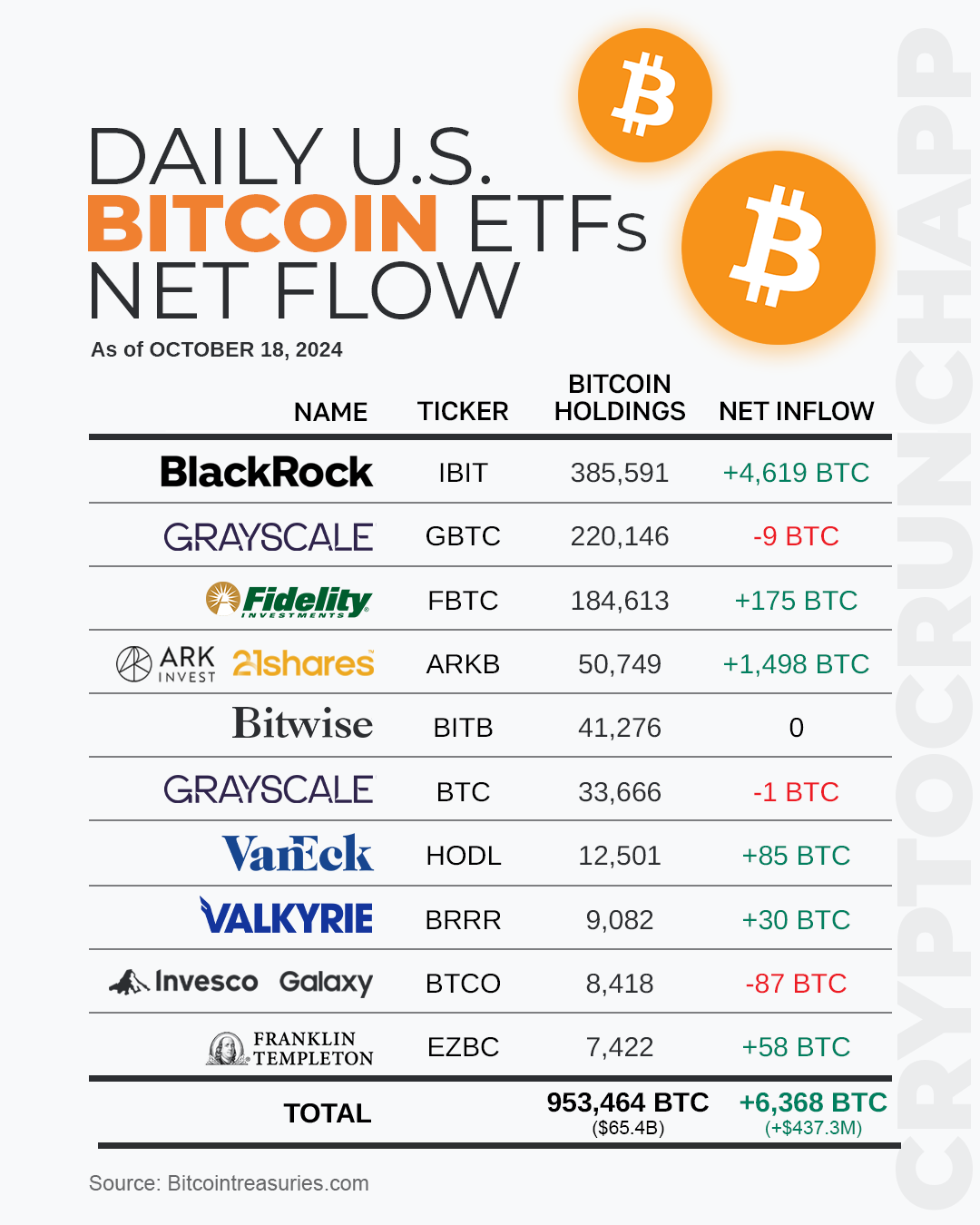
The daily net flow of U.S. Bitcoin ETFs on October 18, 2024, depicted significant activity across various funds. BlackRock’s Bitcoin ETF (Ticker: IBIT) led with a substantial inflow of 4,619 BTC, indicating strong investor interest. Similarly, ARK’s Bitcoin ETF (Ticker: ARKB) also saw a notable increase, receiving an inflow of 1,498 BTC. Fidelity’s Bitcoin ETF (Ticker: FBTC) added 175 BTC, contributing to the overall positive momentum in the market.
Conversely, some funds experienced outflows; notably, the Invesco Galaxy Bitcoin ETF (Ticker: BTCO) saw a reduction of 87 BTC, and Grayscale’s GBTC recorded a slight decrease of 9 BTC. Meanwhile, modest inflows were observed in VanEck’s HODL and Valkyrie’s BRRR ETFs, with 85 BTC and 30 BTC respectively.
In total, the combined Bitcoin holdings for these ETFs amounted to 953,464 BTC, valued at approximately $65.4 billion. The overall net inflow was 6,368 BTC for the day, equivalent to about $437.3 million. This data underscores the dynamic inflow and outflow within the U.S. Bitcoin ETF sector, reflecting varying investor behaviors and market trends.
Disclaimer: Market capitalizations and data can vary in real-time. The information provided here is intended purely for educational purposes and should not, under any circumstances, be construed as financial advice.
Join CryptoCrunchApp on Telegram Channels – Click to Join