Transaction URL: https://blockchain.com/btc/tx/e3945054a4e71f4acfa304e977fdd826edeb80e4799ce74ebeb0e1bb6381e9da

- Crunch
- Global

Paolo Ardoino, CEO of Tether, the leading issuer of crypto stablecoins, expressed optimism about the U.S. crafting favorable crypto regulations after the upcoming elections. Speaking at the DC Fintech Week, Ardoino emphasized the U.S.’s historical lead in technological innovation and stressed the importance of sensible crypto and stablecoin regulations. He highlighted the necessity for laws that protect end-users, noting that effective U.S. policies could set a global standard.
The push for tailored regulations comes amid concerns that current laws do not align with the unique aspects of cryptocurrencies. Ardoino added that his company is committed to enhancing transparency and compliance, amidst past regulatory challenges. With significant political contributions flowing into this election, the crypto industry eyes a supportive framework that could maintain America’s competitive edge in global technology.

Follow Nikolaus On X Here
Earlier today, Vivek discussed why he thinks crypto native Polymarket, the world’s largest prediction market, is biased towards Trump in this upcoming U.S. presidential election. While it is plausible given the arguments he laid out, I still believe that it may not be as biased as he may think.
First and foremost, prediction market traders are betting on these odds to make money, not swear loyalty to their preferred politician….
Read more on BitcoinMagazine
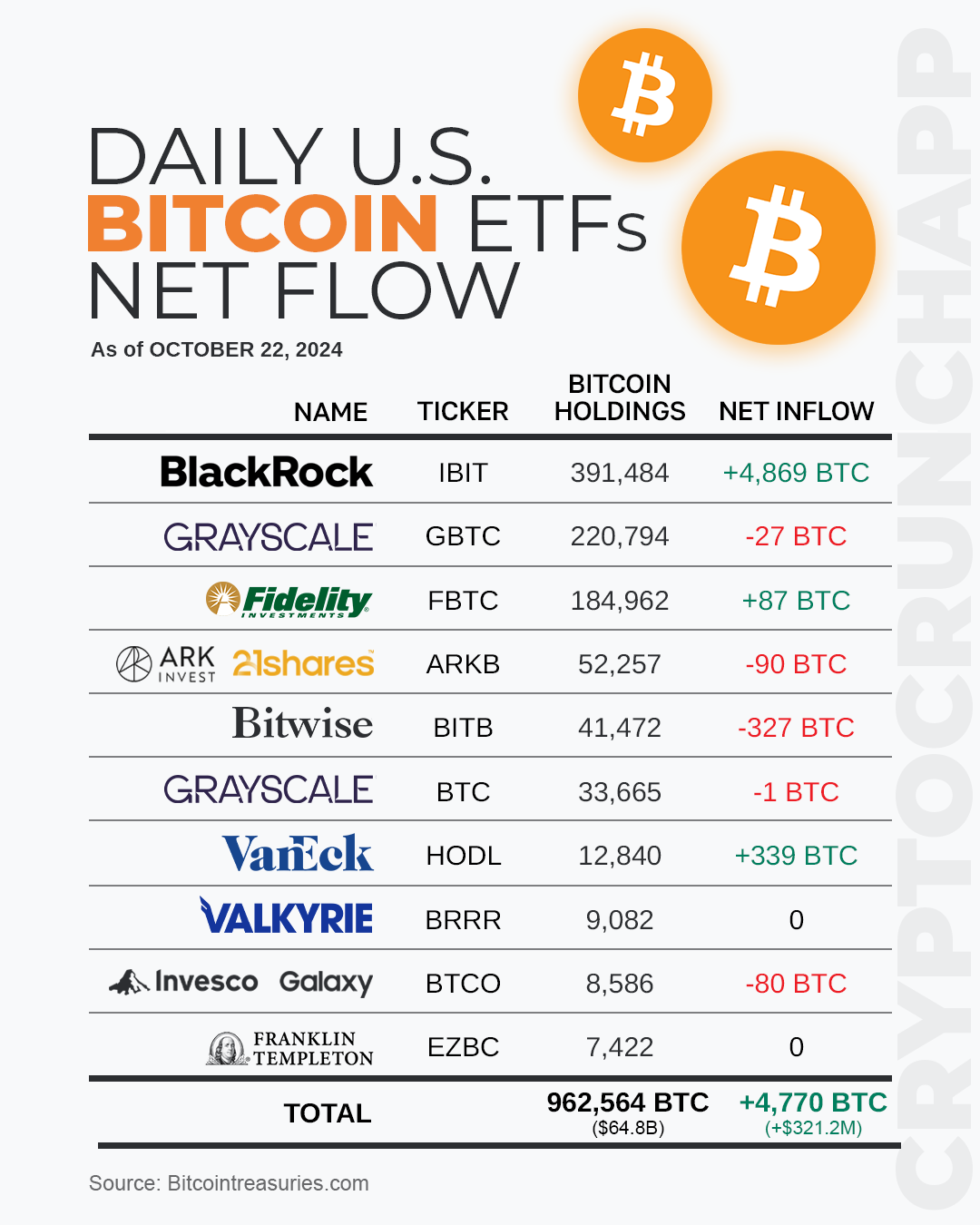
The daily net flow of Bitcoin ETFs in the U.S. for October 22, 2024, displayed a mixture of gains and losses across various funds. Leading the charge, BlackRock’s Bitcoin ETF (Ticker: IBIT) saw a substantial increase, adding 4,869 BTC to its holdings. This was closely followed by a significant gain for VanEck (Ticker: HODL), which added 339 BTC.
On the other hand, some funds experienced reductions. Bitwise (Ticker: BITB) reported a decrease of 327 BTC, and Invesco Galaxy (Ticker: BTCO) saw a reduction of 80 BTC. Grayscale’s Bitcoin ETF (Ticker: GBTC) also faced a slight outflow, losing 27 BTC.
Despite some losses, the overall market movement was positive, with a total net inflow of 4,770 BTC across all funds, valued at approximately $321.2 million. The day ended with the total Bitcoin holdings of these ETFs reaching 962,564 BTC. This activity reflects the dynamic nature of the U.S. Bitcoin ETF market, with substantial inflows indicating strong investor confidence and strategic portfolio adjustments.
Disclaimer: Market capitalizations and data can vary in real-time. The information provided here is intended purely for educational purposes and should not, under any circumstances, be construed as financial advice.
Join CryptoCrunchApp on Telegram Channels – Click to Join

The Lightning Network is a revolutionary scaling solution for Bitcoin, enabling fast and inexpensive payments that make everyday transactions with Bitcoin possible. As the network grows, it’s essential to measure its health and efficiency accurately, so we can unlock its full potential.
Traditional metrics like node count, channel count, and capacity have been used to assess the Lightning Network, but they only tell part of the story. To truly understand the performance of this second-layer solution, we need to focus on flow—specifically, Max Flow, a metric with a long history of optimizing complex systems.
Max Flow: The Key to Understanding Lightning’s Health
Max Flow is a powerful…
Read more on BitcoinMagazine

Follow Frank on X.
This morning, River announced its Bitcoin Interest on Cash feature through which it will offer a 3.8% interest rate — paid out in bitcoin — on the dollars you leave in the custody of the platform, which is FDIC insured up to $250,000.
This yield is comparable to what you’d earn in a high-yield savings account through an online bank like Ally, but again, you’re earning bitcoin with River.
If you’re like me, a Bitcoin enthusiast who…
Read more on BitcoinMagazine
Company Name: Bitaxe
Founders: Skot
Date Founded: Early 2023
Location of Headquarters: North Carolina + remote team
Amount of Bitcoin Held in Treasury: N/A
Number of Employees: ~12 regular contributors
Website: https://bitaxe.org/
Public or Private? Open-source project (not a company)
Bitaxe’s founder, who goes by the nym Skot, has taken his hobby of tinkering with electronics and not only transformed it into a full-time gig but has catalyzed thousands to follow his lead.
Harnessing his training as electrical engineer and his Bitcoin enthusiasm, Skot began deconstructing Bitmain’s Bitcoin mining machines approximately two years ago. After gaining a better understanding of how they work, he…
Read more on BitcoinMagazine