The IMF yesterday announced they have reached a $1.4 billion loan deal with El Salvador. In return, the Central American country that in 2021 made bitcoin legal tender had to remove some of its pro-Bitcoin policies.I spent about three months in El Salvador around the time the Bitcoin law went into effect. I thought then that it was a positive development for the country, but there were aspects of the law that I strongly disliked….
This is a segment from the Empire newsletter. To read full editions, subscribe.
It’s probably safe to say that Donald Trump isn’t really signing transactions on Polygon and Ethereum himself.
Still, those handling the crypto projects he’s linked to are doing their best to have Trump live up to his moniker: The First Onchain President.
I’ve spent the morning compiling onchain data for Trump-linked crypto projects — his NFT collections (trading cards) and upcoming DeFi platform World Liberty Financial.
The goal: Calculate the cumulative value of Trump’s onchain footprint.
It was a quick analysis, but the data shows that Trump has so far raked in almost $84…
Today, the Human Rights Foundation (HRF) announced its most recent round of Bitcoin Development Fund grants, in a press release sent to Bitcoin Magazine.
700,000,000 satoshis (7 BTC) currently worth $706,000 at the time of writing, is being granted across 20 different projects around the world focusing on technical education for people living under authoritarian regimes, independent media outlets, decentralizing mining, and providing human rights groups with more private financial solutions — with a main areas of focus for these grants center around countries and regions in Latin America, Asia, and Africa.
While the HRF did not disclose how much money each project is receiving…
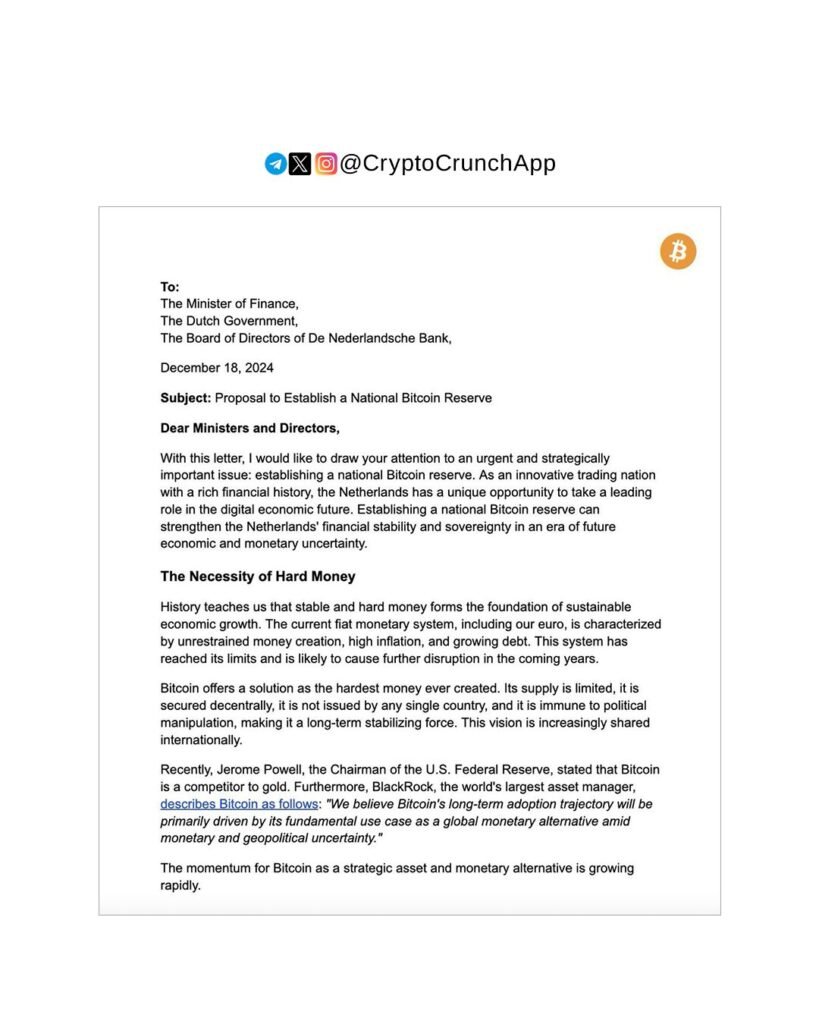
Financial expert Bram Kanstein is pushing the Dutch government to establish a national Bitcoin reserve, positioning the Netherlands at the forefront of the digital financial revolution. He proposes funding the acquisition through a portion of the nation’s gold reserves or by issuing new government bonds. This bold move comes amid growing global monetary instability, including rising inflation and soaring national debts.
Kanstein argues that Bitcoin, with its decentralized, finite nature, serves as robust “hard money” against economic volatility and political manipulation. Unlike traditional fiat currencies plagued by instability, Bitcoin offers a secure alternative, underlined by its limited supply and global recognition as a serious financial asset. Notable endorsements include comments from Jerome Powell, Chairman of the U.S. Federal Reserve, likening Bitcoin to gold, and BlackRock’s support for cryptocurrency as a potential monetary standard.
By embracing Bitcoin, the Netherlands could safeguard its economy from future financial crises and maintain its historical role as a leader in trade and technological innovation. Kanstein’s proposal underscores a strategic opportunity to ensure economic stability and prosperity for future generations, urging the Dutch government to seize this visionary initiative.