Google updates policy to allow ads for US crypto trusts

Tech giant Google has updated its cryptocurrency-related advertising policy to allow ads about crypto trusts from the end of January, the same month that spot Bitcoin (BTC) exchange-traded-funds are predicted to be approved in the United States.

In a Dec. 6 policy change log, Google said its crypto and related products ad policy will be updated on Jan. 29, 2024, to allow ads from “advertisers offering Cryptocurrency Coin Trust targeting the United States.”

Cryptocurrency Coin Trusts were exampled as “financial products that allow investors to trade shares in trusts holding large pools of digital currency” — likely including ETFs.

“As a reminder, we expect all advertisers to…

Read more on Cointelegraph

DeFi protocol Venus seeks to patch $270K hole from oracle incident

Decentralized finance protocol Venus has confirmed it was impacted by an issue with one of its price feed oracles resulting in borrows totaling around $270,000 on Dec. 11, but has downplayed the incident from being an “exploit” as described by analysts, and also vowed to replace funds from the treasury. 

On Dec. 10, reports started emerging that the Binance Chain-based decentralized lending and borrowing marketplace had been affected by a malfunctioning price oracle.

X user ‘@SaulCapital’ alerted followers that the “isolated pool on Venus Protocol for liquid staked BNB got exploited.”

He posted a link to a suspect wallet address involved in the incident, which held just under…

Read more on Cointelegraph

Google’s Gemini demo is now getting accused of being ‘fake’

A “hands-on” tech demo of Google’s new artificial intelligence model Gemini has gone from being the talk of the town to being accused by critics of being “basically entirely fake.”

The six-minute video, which garnered 2.1 million views on YouTube since its release on Dec. 7, shows it seamlessly interacting with a human operator in seemingly real-time, including analyzing a duck drawing, hand gestures, and inventing a game called “Guess the Country” with just an image prompt of the world map. 

However, Oriol Vinyals, a Google Deepmind executive has since clarified that while the user prompts and outputs in the video are real, it has been “shortened for brevity.” In reality,…

Read more on Cointelegraph

Bitcoin wipes nearly a week of gains in 20 minutes, falling under $41K

The price of Bitcoin (BTC) briefly fell below $41,000 following a sudden 6.5% drawdown from $43,357 to as low as $40,659 in just 20 minutes at 2:15am on Dec. 11 (UTC). 

At the time of publication, Bitcoin was trading slightly up from the local low at $41,960 per TradingView data. 

According to data from CoinGlass the brief drop caused more than $271 million worth of long positions to be liquidated. 

Ether (ETH), the second-largest cryptocurrency by market cap, also witnessed an abrupt decline, falling more than 8.9% in the same time frame. The price of ETH has since stabilized and is trading for $2,233, down 5.3% on the day. 

Bitcoin had just closed its 8th green weekly candle, according…

Read more on Cointelegraph

Web3 Watch: Solana and Bitcoin top Ethereum in NFT sales

This week’s Web3 watch begins with a significant shift in the NFT marketplace. Ethereum, traditionally the frontrunner in NFT trading, has seen a downturn in sales volume, facing competition from two emerging players.

The Bitcoin network witnessed a surge in digital art collectible trading, primarily driven by ongoing interest in ordinal inscriptions. Ordinals allow users to mint NFT-like assets directly on the Bitcoin blockchain. The past month has seen a 500% increase in sales volume for this asset class, eclipsing Ethereum’s figures over the same timeframe.

The popularity of Bitcoin’s cheap-to-mint ordinal inscriptions has led to a significant increase in demand on the network….

Read more on Blockworks

Solana memecoin Bonk flips Pepe following 370% monthly gain

A Solana-based dog-themed memecoin called Bonk (BONK) has now become the third-largest memecoin by market capitalization, surging past that of fellow memecoin Pepe (PEPE) on Dec. 8.

Bonk’s recent price growth — 370% in the last month — has seen its market cap grow to $762 million, compared to Pepe’s current $675 million market cap, per CoinGecko data.

In the past 30 days, BONK has grown from $0.0000028 to $0.000012 as traders rushed to capitalize on a new wave of interest in the Solana ecosystem.

Bonk’s price has grown 370% in the last month. Source: CoinGecko

Bonk’s rapid uptick in price also outpaced the growth of other more well-established dog memecoins such as Shiba (SHIB)…

Read more on Cointelegraph

Bitcoin bulls’ run toward $45K could produce tailwinds for UNI, OP, TIA and STX

The S&P 500 Index (SPX) achieved its highest close of the year last week, and Bitcoin (BTC) also hit a new 52-week high, indicating that risky assets remain strong going into the final few days of the year. 

Some analysts believe Bitcoin is done with its rally in the short term and may roll over. Popular analyst and social media commentator Matthew Hyland cautioned in a post on X (formerly Twitter) that a drop in Bitcoin’s dominance below 51.81% could signal that the uptrend has ended “along with a likely top put in.”

Crypto market data daily view. Source: Coin360

Usually, the first leg of the rally of a new bull market is driven by the leaders, but after a significant move,…

Read more on Cointelegraph

Bitcoin inscriptions added to US National Vulnerability Database

The National Vulnerability Database (NVD) flagged Bitcoin’s inscriptions as a cybersecurity risk on Dec. 9, calling attention to the security flaw that enabled the development of the Ordinals Protocol in 2022.

According to the database records, a datacarrier limit can be bypassed by masking data as code in some versions of Bitcoin Core and Bitcoin Knots. “As exploited in the wild by Inscriptions in 2022 and 2023,” reads the document.

Being added to the NVD’s list means that a specific cybersecurity vulnerability has been recognized, cataloged, and deemed important for public awareness. The database is managed by the National Institute of Standards and Technology (NIST), an agency of…

Read more on Cointelegraph

Block size and scalability, explained


What is block size, and why is it important?

Block size is important for maximizing storage efficiency and transaction throughput in file systems and blockchain contexts. 

The amount of data processed or transferred in a single block within a computer system or storage device is referred to as the block size. It represents the basic unit of data storage and retrieval in the context of file systems and storage.

Moreover, a smaller block size facilitates more efficient utilization of storage capacity, reducing the likelihood of unused space within each block and eliminating wasted space. On the other hand, by lowering the overhead involved…

Read more on Cointelegraph

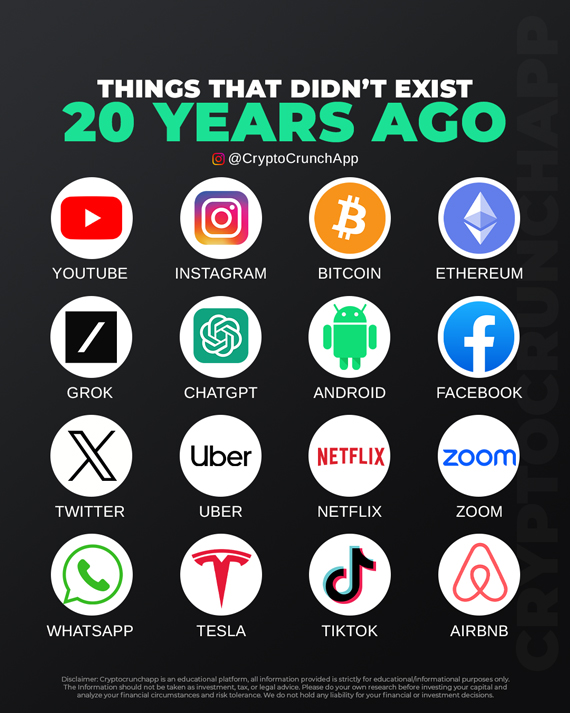
The Evolution of the Digital Revolution: Navigating the Last 20 Years of Change

As we navigate through the 21st century, the velocity of technological change is breathtaking. Within a mere twenty years, a new wave of companies and products has emerged, transforming every aspect of our lives. These innovations have redrawn the map of social interaction, entertainment, finance, and beyond, setting a precedent for continuous evolution in the digital era.

The Social Fabric Redefined

The advent of platforms like YouTube and Instagram marked a paradigm shift from passive consumption to active creation of content. This era of user-generated media democratized storytelling and opened up new avenues for creativity. Similarly, Facebook and Twitter did not just provide platforms for sharing but also became new public squares, reshaping political discourse and community building. WhatsApp’s entry made global communication instantaneous and borderless, redefining the very nature of personal and business interactions.

Financial Frontiers Explored

The emergence of Bitcoin and Ethereum introduced the world to cryptocurrencies and blockchain, signaling a shift towards a future where financial sovereignty and privacy are paramount. These digital currencies offer an alternative to traditional banking, suggesting a future where transactions are secure, transparent, and decentralized.

A Technological Renaissance

The rise of Android signified more than just the proliferation of smartphones; it heralded an era where access to information became universal. With artificial intelligence, exemplified by tools like ChatGPT, our interaction with technology has become more natural and intuitive, promising a future where AI could become an extension of human intellect.

Entertainment Revolutionized

Netflix’s on-demand model disrupted the entertainment industry, granting viewers the freedom to choose what to watch and when. The rapid ascendancy of TikTok illustrates the public’s appetite for bite-sized, engaging content, altering the entertainment landscape and content creation.

Revamping Transportation and Hospitality

In transportation, Uber and Tesla stand as vanguards of change. Uber’s ride-sharing concept revolutionized urban mobility, while Tesla’s vision propelled the automotive industry towards sustainability. Airbnb’s platform transformed the way we travel, offering more personalized lodging experiences and reflecting a growing preference for authenticity over traditional tourism.

Redefining Work and Community

The explosion of Zoom during the global pandemic underscored the importance of connectivity, as remote workspaces became the norm, and physical distance was bridged by digital closeness.

The last 20 years have not just seen the birth of new technologies but the inception of a new way of life. The patterns emerging from these innovations point towards a future that is more interconnected, more efficient, and more attuned to the needs of the planet and its inhabitants. As we look ahead, it is clear that the world as we know it is being continuously redefined by the boundless potential of human creativity and technological progress.

Disclaimer: Market capitalizations can vary in real-time. The information provided here is intended purely for educational purposes and should not, under any circumstances, be construed as financial advice.