

- Crunch
- Global

KuCoin Research believes that the low float, high FDV trend in crypto led investors to other options like Notcoin, which had all its tokens circulating during launch.
Read more on Cointelegraph

MicroStrategy plans a $500 million stock sale to fund additional Bitcoin acquisitions, reinforcing its commitment to BTC as a treasury reserve asset.
Read more on Cointelegraph

MicroStrategy has launched a private offering of $500 million in convertible senior notes, slated for 2032. This strategic financial move is aimed at increasing its Bitcoin investments, demonstrating a robust confidence in cryptocurrency as a key asset. With conditions permitting, an additional $75 million could be added within 13 days of the initial release.
The notes, unsecured and bearing semi-annual interest, represent a significant step for MicroStrategy in reinforcing its commitment to Bitcoin. They will mature by June 2032 and could convert into cash or shares of MicroStrategy’s class A common stock. This flexibility highlights the adaptability of MicroStrategy’s investment strategy toward prevailing market conditions.
Set for sale to qualified institutional buyers, this initiative underlines an optimistic outlook for Bitcoin’s role in future corporate asset strategies. The move not only emphasizes the growing acceptance of cryptocurrencies but also positions MicroStrategy at the forefront of digital asset investment.

Google Cloud’s report exposes North Korean cybercriminals targeting Brazil’s cryptocurrency and fintech sectors with sophisticated malware and phishing schemes.
Read more on Cointelegraph

Bitcoin bulls run out of steam yet again as BTC price action returns to its pre-CPI position.
Read more on Cointelegraph

$1M – $10M MarketCap:
- BloodLoop ($BLS): 34%
- Minu (MINU): 27%
- Egochain (EGAX): 20%
- Aark Digital (AARK): 20%
- StoryFire (BLAZE): 12%
$10M – $100M MarketCap:
- Beefy (BIFI): 81%
- Ultima (ULTIMA): 39%
- Nibiru (NIBI): 26%
- Gari Network (GARI): 23%
- NvirWorld (NVIR): 20%
$100M – $1B MarketCap:
- io.net (IO): 43%
- MAGA Hat (MAGA): 24%
- BakerySwap (BAKE): 23%
- Banana Gun (BANANA): 19%
- Livepeer (LPT): 14%
Disclaimer: Market capitalizations can vary in real-time. The information provided here is intended purely for educational purposes and should not, under any circumstances, be construed as financial advice.
Join CryptoCrunchApp on Telegram Channels – Click to Join

Synonym’s Bitkit, a self-custodial Bitcoin wallet, launches on iOS and Android, promoting user control over BTC transactions without third-party intermediaries.
Read more on Cointelegraph

Polygon’s zero-knowledge self-sovereign identity solution looks to provide privacy with assured authenticity.
Read more on Cointelegraph

In a strategic move during Bitcoin’s recent price decline, significant investors known as Bitcoin whales have acquired 20,600 BTC, valued at approximately $1.38 billion. This record inflow, observed by blockchain analytics firm CryptoQuant, marks the most substantial single-day purchase since February 28. During that period, the excitement around the nascent spot Bitcoin exchange-traded funds (ETFs) was surging as Bitcoin neared an all-time high.
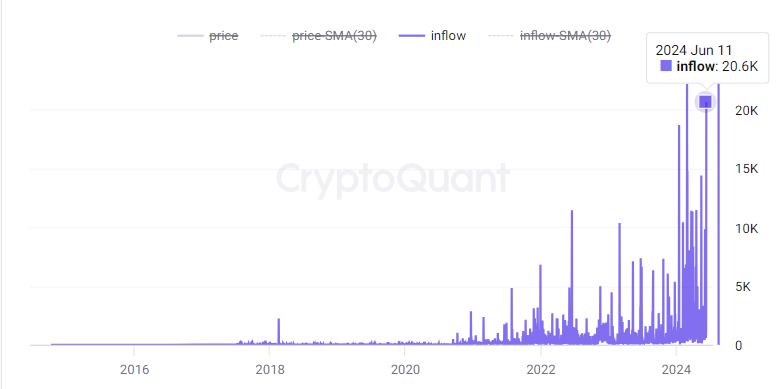
From June 7 to June 11, as Bitcoin prices dipped from $71,650 to around $69,000, inflows into whale accounts varied between 1,300 and 2,200 BTC daily. This trend was disrupted by a sharp price drop that prompted whales to significantly increase their holdings.
The trading landscape received a brief boost on June 12 following encouraging U.S. Consumer Price Index results, with Bitcoin trading at $67,500. This ongoing accumulation by whales underscores their confidence in Bitcoin’s resilience and potential for recovery.